Category Archives: Articles

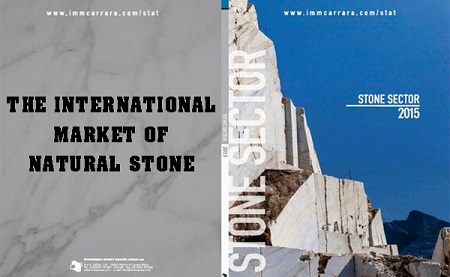
THE INTERNATIONAL MARKET OF NATURAL STONE

The annual statistics publication by Internazionale Marmi e Macchine (IMM) presented. China, the leading figure and Italy in second place with a rapidly changing scenario. Signs of recovery in the construction sector. Italian districts leading exports, characterised by the quality and high added value of products.

In 2014, natural stone (marble, granite, stone, travertine) recorded world trade of 86 million tons, +7.4% compared to 2013, for a value of 22.8 billion (+1.8%) with a stabilisation of market shares among the top ten countries but with interesting variations in the percentages. China continues to hold the largest share of the market with 35.8% (among the most important partners, Japan and the countries of the area), followed by Italy with 13.5%, a stable market in terms of finished products with high added value. Turkey holds 12.1% (down consistently compared to the 12.9% in 2013) followed by India (10.8%) and Brazil with 7.0%. The performance of Iran is interesting. In one year only, Iran increased its share from 1.1% to 1.8% and stands out in terms of production, exports and domestic consumption as well as its imports of Italian technology.

The target market for natural stone is the construction industry, which in 2014 stood at 6,800 billion euro, of which 51% is attributed to Asia picking up after seven years of general crisis. The Stone Sector edition 2015, the publication that the Internazionale Marmi e Macchine produces each year with its research department, presents the results and the prospects for the international trade of stone. It includes the numbers and percentages along with assessments of trends and prospects. “A useful tool for everyone, operators, specialists and institutions – were the opening remarks from Fabio Felici, Chairman of IMM Carrara – that is only part of our company mission, which is to study the industry, understand and report the dynamics and promote the use of stone. What we offer, in fact, are not mere statistical tables but also reflections on current or emerging trends in Italy that affect more than 10,000 companies and over 50,000 employees that form a group of true excellence but also have to face complex problems that can only be addressed if discussed and shared”. In the illustration of the trends of a sector closely linked, both nationally and internationally, to the construction sector, the weight of individual countries with the weight of their economies and domestic markets clearly emerges. “China, stressed Manuela Gussoni, head of the IMM research office, when giving details of the publication – showed a total export value of 4.6 billion in 2014 (+5.6% compared to 2013). Granite makes up 70% of the total (3.2 billion euro, +6.4%), exported in particular to South Korea and Japan but exports of finished marble products are also growing (1.3 billion euro, +4.5%) exported in particular to the US. China is also the leading country for imports with 14.7 million tons (+%) purchased mainly from Turkey that is now affected by the slowdown in Chinese demand. The second largest market for domestic demand is the United States that imported products for nearly 2 billion euro (5%) while – said Gussoni – there are signs of a recovery of the European market with the EU countries that imported products for a total value of 2.3 billion euro, with a small 0.3% increase, yet far from the 2.6 billion in 2012”. Italy, firmly in second place worldwide, exported 4,194,035 tons of marble, granite, travertine and other materials, both raw and processed, in 2014 to a value of 1,940,861,130 euro with a surplus of more than 1.5 billion euro. The driving item was finished marble products that, despite a 3.5% decrease in quantities exported, recorded an increase in value of 3.8% with exports of 891,933 tons of finished marble for almost 936 million euro. That means an average unit value of 1049 euro per ton (+7.5%) while exports of marble in blocks and slabs stood at 1.3 million tons for a value of 331 million euro. The quarrying and processing companies, particularly the export-oriented ones, have played an important role in the Italian trend and the organisation of the districts in which they operate and the quality of the employees is an important hallmark on the international markets. 10,698 companies (1,084 in the quarrying sector) that in 2011 had a total of 54,201 employees. The highest concentration of employees was in the Veneto district (Verona, Padua, Vicenza) with 5.634 employees followed by the Apuo-Versilian district (Massa Carrara, Lucca Spezia) with 4.511 and the Puglia stone district (Bari, Battipaglia-Andria-Trani, Foggia, Lecce) with 3.822 employees. The Lombard district (Bergamo and Brescia) was fourth with 3.340 employees.  In the general assessments, the export flows and values play a significant role. Again in 2014, the Apuo-Versilian stone district came out on top (Massa Carrara, Lucca, Spezia) exporting finished products for a value of 481 million euro, with a growth of +0.9% compared to 2013. The Veneto district (Verona, Padua, and Vicenza) followed with 475.4 million euro.Italian production, according to the Stone Sector by IMM, shows a recovery in exports to UE countries (value of 485 million and +4, 7%) thanks to Germany and the UK and the value of exports to the USA continues to grow (371 million, +2, 3%) despite a reduction in quantity in favour of quality. The value of exports to the Middle East is decreasing except for Kuwait, the Arab Emirates, Lebanon and Israel. China too lowered its imports in 2014.Today, the IMM study concludes, analysing the characteristics and opportunities of the markets, the key words for the definition of any successful business strategy are sustainability and innovation combined with the recovery and use of waste, the short chain with a low environmental impact and the product design, environment and employment as shared values for the social legitimacy of the entire chain.For small and medium-sized companies in the marble sector, exciting opportunities are opening up tied to the creation of a local chain of production of products with high added value to be distributed through a global network by introducing innovation and exploiting the combination of new digital technologies with traditional manufacturing implemented by constant and proper communication of the identity value of marble with marketing strategies to promote products with a high added value.Giampaolo Vitali, CNR Researcher and secretary to the Group of Company Economists, presented the data collected by the economic Observatory on the Italian stone districts and the activity of the major companies operating in the territories concerned. “In 2013, the capital companies altogether, recorded a national turnover of almost 4 billion Euro said Vitali – and the Apuo-Versilian and Verona districts show their leadership with approximately 900 million turnover each. The same statements apply to employment and number of companies: the weight of Verona and the Apuo-Versilian district is double the districts of Lombardy, and 5-6 times compared to the other districts of the North (Piedmont, Lombardy and Trentino) and Central-South Italy (Lazio, Puglia, Sicily, Sardinia). The impact of the general crisis in the sector was heavy on a national level, with a fall in turnover of 12% in 2009 and a recovery in 2010 and 2011, with a subsequent settling in 2012 and 2013. The final figure for 2013 is still lower than the initial one of 2008, especially in the quarrying sector compared to the processing sector. Within this national dynamics, territorial performance is very different, with the Tuscan district that shows a level of turnover in 2013 10% higher than in 2008, while the districts of the Lazio, Puglia, Trentino and Sicily are still lower 20%. Because of stagnation in the national demand, exports have become the main driver of the recovery in the stone industry as indeed in much of the Italian manufacturing industry. To this regard, the Observatory (which stems from a partnership between the CNR and IMM) has analysed the performance of exports of individual Italian companies and found that of the 1,131 companies in the production chain that export directly, a good 220 operate in the Tuscan district, and of these the 20 leading companies account for almost three quarters of total exports.Concluding the talks was Daniele Mocchi from the Institute of Study and Research (ISR) of the Chamber of Commerce of Massa-Carrara showing the results of the annual survey on the financial statements of a sample of 281 capital companies in the quarrying, processing and mechanical sectors with registered offices in the province of Massa Carrara. “The quarrying sector (which since 2007 has shown positive performance) is in excellent health with record values compared to 2013 and the data for the processing sector are positive too with sales up 5% compared to 2012 and by more than 9% on 2011. This has made it possible – said Mocchi – to close the accounts of companies in this segment with profits again in 2013, generating a production value of nearly 436 million euro with a profit of 9.4 million. The 51 quarrying companies monitored, however, generated a production value of 107 million euro, with double the margin compared to the previous year (currently 16.5 million euro). “For the mechanical sector, despite the excellent turnover, which grew by +14% and +18% on 2011, 2013 closed with a general loss of 187,000 euro.

Annual statistics publication by Internazionale Marmi e Macchine (IMM)

http://www.immcarrara.com/

600-eng

Quartz and white marble remain growing trends of kitchen design

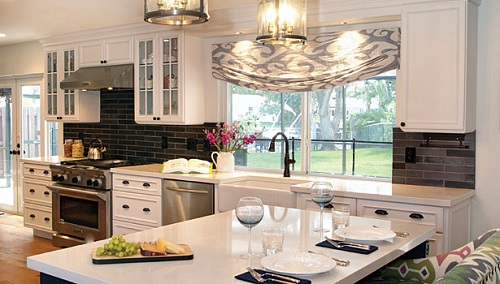
When it comes to the kitchen — the most popular space in any residence — quartz and white marble remain growing trends, while mitered corners are also often requested for countertops

When it comes to aesthetics, homeowners are usually looking to incorporate what’s trending and what’s “hot” on the market to make each space unique.

When speaking with fabricators along the East Coast, it’s apparent that granite is not the only popular choice for countertops anymore. “Everyone wants white marble,” said Tim Farr, owner of StoneWorks in Augusta, Inc. in Augusta, GA. “It’s just really popular. We see some quartz, but for the most part, it’s everything light and white. People are moving away from the staple colors to the whites.”

ys (1)

Marco Duran, co-owner of Atlas Marble & Granite in Springfield, NJ, also is seeing a trend towards marble countertops. “The most popular [materials] right now are marble or quartzite,” he said. “On a scale from one to three, with one being the most popular, I’d say marble is at one, with second, being quartzite. I think marble is the most popular only because people are not really aware of quartzite.

As an interior designer, Alena Capra, CKD, CBD of Alena Capra Designs in Fort Lauderdale, FL, said she has been working with a tremendous amount of white quartz lately. “I’ve done work in New York City as well as Florida, and more people are very much looking to do neutral quartz counters,” she said.

Anna Marie Fanelli, designer and vice president of Floor & Decor in Tenafly, NJ, echoed Capra’s comments and said her clientele is also requesting a lot of quartz to use for their homes. “I’ve introduced them to Dekton [by Cosentino], an ultra-compact material composed of glass and porcelain and the highest quality quartz material that can go on the inside and outside of buildings,” she said. “It comes in monochromatic colors — blacks and different types of whites. The technology is crazy; it’s amazing. I’ve used it for fireplaces, kitchens and bathrooms.

ys (2)

Selecting the right edge

When it comes to edges, the mitered edge has been growing in popularity, but for some areas of the country, it has already been around for a handful of years. “We took an interest in that maybe four to five years ago,” said Duran. “I just always like that look of miters and clean lines. From a personal standpoint, I want to impose that in our showroom. Pretty much, it’s more of a foresight in people’s minds. I was ahead of the trend when it came to miters in natural stone. We partook in mitering way before people took an interest in it. Now that there’s an interest in it, it’s like second nature to us. If you look at people who are trending, their choices are directed towards quartzite or stones, and those are complemented by mitered edges.”

Farr agrees that his shop is seeing more of the mitered edge. “It’s coming, I will tell you”, said Farr “If folks are not prepared, they better start to [get prepared]. [But], I think it’s just a trend. That’s part of the reason for us buying a new CNC saw — it’s more efficient. Our old saw didn’t miter, and this one does. It makes it simple.”

ys (3)

Polished verses honed

While many people tend to veer towards a polished finish, which is highly reflective, displaying the vibrancy and character of the stone’s natural colors, it really depends on the type of material being used and its application. “If I’m working with marble, it’s most likely honed,” said Farr. “There are some people that want the polished look. I’d say it’s probably a 70 to 30 ratio. About 70% want a honed finish and 30% want a polished finish.”

Duran said most of his customers are looking for the same things. “Honing is advantageous to having marble — people will drift towards honed tops,” he said. “If it’s marble, I’m almost positive they’re going for a honed finish; there’s probably a 3-to-1 ratio they’re selecting honed over polished. The polished finish — people are going just for the look of it.”

According to Fanelli, she believes the two finishes are equally popular. “It was always honed, but now it’s 50/50,” she said. “I’ve even done polished materials in the kitchen in porcelain. Before it was honed, honed, and honed. Now, it’s a combination of both.”

From Capra’s standpoint, she’s seeing the opposite, with the polished trend standing strong. “In this case, I am finding the tradition that kind of stays, for the most part, is polished countertops,” she said. “Not a lot of people are doing honed countertops. They keep trying the honed trend, but I don’t think it is happening. A shiny piece of stone in your kitchen contrasts so nicely. Most cabinets are wood, so I think it creates a beautiful, stunning contrast to have that polished top. I really don’t get asked for honed as much as I do for polished.

ys (4)

The future of stone

A couple of years ago, people were really looking for ways to save on stone products, while also being able to accomplish an upscale design. Today, the trend has totally shifted. Now, instead of worrying about cost, people are starting to indulge in the luxury items they really want, looking at it as an investment.

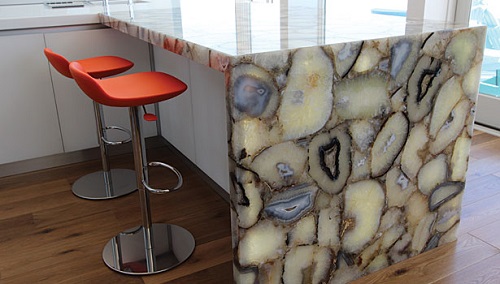
“The future is in semi-precious stones and the ultra-high-end market,” said Duran. “The luxury goods market is basically coming out of its shell. We’ve been predicting that for about a year now that there is a call now for a luxury product that is beyond white marble, exotic granite and engineered stone. We feel that luxury is coming back. People, again, are sort of having what they desire, instead of what is common. Granite is attainable and common — and people are looking for opulence and luxury — and that’s what is with a semi-precious collection. It’s got qualities that make it look so unique — as unique as the individual wants to be. People say, ‘This is what makes me different — having this surface. Not everyone can afford it.’ And that market is starting to bloom. It’s becoming fashionable.”

“What I’m seeing with kitchen backsplashes are a lot of stone with mirror, stone with gold, stone with platinum — a lot of mixing with exotic materials,” said Fanelli. It’s different these days; they have upscale feelings. People are saying to me, ‘The Kardashians did it,’ so you have this mindset of ‘the celebrities did it, now I can do it.’ It’s an interesting way of looking at it. If they have to spend $4,000 to $5,000, they will now. They’ll say it’s an investment; before, it was ridiculous, now it’s artwork, a specialty.”

Heather Fiore, associate editor of TILE Magazine

www.stoneworld.com

The UK stone market report January 2014 – part 5

Growth returns to the UK – report February 2011

This report was first published in the Official Catalogue of the Natural Stone Show 2011. To download the pages from the catalogue as PDFs, click here. To go to the Natural Stone Show website, click here.

Last year (2010) ended as it had begun in the British Isles – under several centimetres of snow. That might make for some pretty pictures but it tends to shut down construction sites and bring the UK and Ireland, which just aren’t geared up for snow, to a grinding halt.

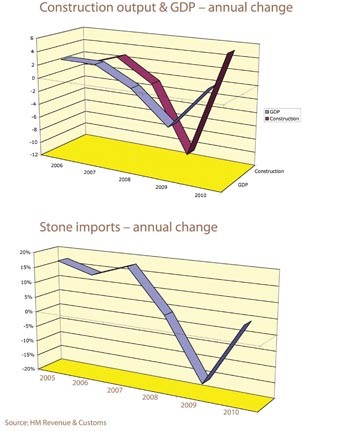
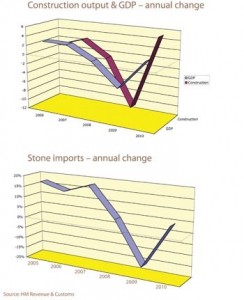
Yet in spite of the problems posed by the weather, both the construction industry in the UK and the economy in general returned to growth in 2010, although the snow did take its inevitable toll on the construction sector with output falling in both the first and fourth quarters of the year.

Nevertheless, the industry performed well in the second and third quarters to grow 5.1% in the year overall, contributing to 1.4% growth in the economy as a whole.

There are no equivalent figures produced in the UK for the stone industry, but with around three-quarters of the stone used in Britain being imported, import figures provide a good snapshot of trends in the industry. And they indicate growth last year was more than 4%.

The fall in construction output in the final quarter of last year could simply mean that work moves forward a month or so, as it did last year.

There are some major developments coming on stream this year and the Olympics are boosting demand for stone in London as hotels, restaurants and public areas such as underground stations prepare for the 2012 games.

Certainly anecdotal evidence from the suppliers of machinery and consumables supports the proposition that the stone industry is gearing up for the opportunities of the year ahead.

There has not been much investment in machines by masonry companies in the UK or Ireland since the world’s bank debt crisis started hitting the rest of the economy in 2008. But according to the companies selling the almost exclusively imported stone processing machinery that is used by the UK stone industry, processing companies started investing again last year to give themselves an edge in an increasingly price sensitive and competitive market place.

That price sensitivity has continued to benefit stone suppliers from the Far East. UK imports from China grew by more than 10% last year and India did even better, up more than 15%. Imports from Asia now account for 58% of stone coming into the UK by value and 68% by volume.

The value of stone imports from Asia first became greater than imports from Europe in 2007 and they have stayed ahead ever since.

Italy is the main European supplier of stone to the UK, but exports to the UK have been hit hard by the fall in the value of sterling, which has increased the price of imports in the UK.

The weakness of sterling has increased the prices of imports from Asia as well as from Europe, but the Chinese and Indians have done more to keep their prices down. Italy has practically conceded the battle on price and is looking to add extra value to the stone it is selling.

You will be able to see some of the ways the Italians are doing that at the Natural Stone Show in the Marmomacc Meets Design feature.
1

They are using their sophistication in design and production to create intricate stone products rather than the more prosaic polished slab, tiles, hard landscaping and memorials that tend to be bought from Asia.

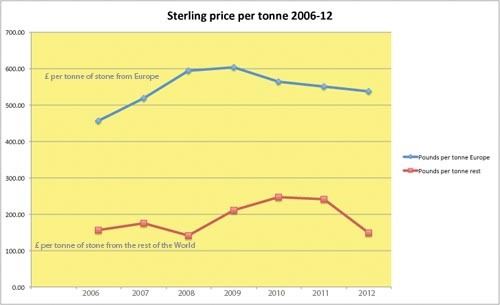
The Italians have certainly increased the price of the products they are selling to the UK. The average price of stone imports from Italy last year was £990 a tonne, compared with an average price from China of £298 a tonne and from India of £223 a tonne.

That probably explains why stone imports from Italy fell by about 40% last year, according to the figures compiled by HM Revenue & Customs.

While most stone used in the UK for most purposes these days is imported, there remain about 300 active quarries run by about 200 operators producing dimensional stone in the UK.

The UK has practically no marble and there is not much granite being extracted these days because it cannot compete with the prices of Asian imports, but the UK does have a good selection of limestones, sandstones and slates that are used for building, interiors and hard landscaping.

It is in demand by the conservation and repair, maintenance & improvement sectors, but is also used in new build, especially in sensitive areas where planners want traditional materials used and in impressive, prestigious buildings where architects want to make a statement. British limestones, sandstones and slates are also used for interiors, especially, but not exclusively, for floors. The subtle, subdued hues of the stones of the British Isles lend themselves to unpolished finishes making statements of quiet authority.

The dimensional stone production industry in the UK is so small that it is considered too commercially sensitive to produce figures about the industry. However, the producers report reasonable strength of demand for their products.

Walling for housing developments has fallen in line with the collapse of housebuilding in general, but where projects are still going ahead the weakness of sterling is making UK stone more competitive against imports.

There was more British stone than ever before being exhibited at the Natural Stone Show this year.

In Ireland, life is hard.

For many years the Celtic Dragon enjoyed greater growth than the UK and invested heavily in equipment to extract and process its own and imported stones. Stone from the UK often went to Ireland for processing because their level of investment gave processors there a competitive advantage.

But the growth peaked in 2006 and they have been in decline since then. In 2009, construction output was just 39% of what it had been in 2006. And by the third quarter of last year (the latest figures available at the time of writing) it had fallen another 39% year-on-year.

But there are signs that the decline in construction in Ireland has reached the bottom of the curve. The economy in general is, perhaps, improving with the government forecasting 1.7% growth this year.

Construction played a major part in the spectacular growth of Ireland that averaged 6% between 1995 and the end of 2006. In 2006, Ireland’s GDP per capita was greater than America’s.

The country’s population was growing as a result of immigration and for the first time in 100 years exceeded 4million, peaking at nearly 4.5million. The extra people needed more houses to live in and offices and factories to work in. Construction boomed.

Fuelled by strong economic growth, immigration and generous tax incentives and grants from the government, as well as low interest rates and loose credit making borrowing easy, property prices increased more rapidly in Ireland in the decade up to 2006 than in any other economy of the developed world. Between 1996 and 2006 prices more than trebled, even though annual completion rates also trebled to 93,000.

Construction seemed to offer guaranteed, no-risk returns, and speculative building raced on. With the crash, Ireland has been left with more buildings than it needs (an excess of 300,000 houses, 17% of its housing stock, according to a report by University College Dublin in 2010) and prices have collapsed, although there were still nearly 20,000 dwellings built last year.

According to the Permanent TSB/ ESRI house price index almost a decade of price rises have been wiped out since 2006. In the third quarter of 2010 the average price of a house fell a further 14.8%, to Euro198,689, compared with a year earlier. That is 36% down on the peak at the end of 2006.

Stone sales in the UK – report May 2010

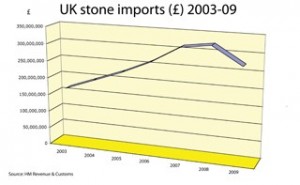
Stone imports to the UK went into decline last year after having held up reasonably well in 2008, when the value of imports was 4% above the 2007 figure. In 2009 the value of imports fell 16%. But that flatters the position. The weakness of stirling (a 15% fall against the Euro and a 25% fall against the US dollar compared with 2007 rates) increased prices through the poor exchange rate. Volumes of stone imports fell by 43%, according to UK government figures.
2

The UK stone industry got off to a good start in 2008, continuing the exceptional growth that had started in 1996 and continued on a general upwards trend well into double figures ever since. However, as the year progressed the reality of the recession started to bite and after April sales began to fall. The year still showed that increase in the value of imports on 2007 overall. Of course, the rise in prices must also have played its part in curtailing demand.

Imports account for the majority of stone sales in the UK. The indigenous stone quarrying industry is so small that no accurate figures for extraction of dimensional stone from the 300 quarries active in the British Isles (which includes Ireland) exist. Anecdotally, sales of British stone had been pulled along with the general increase in demand for stone in Britain throughout the second half of the 1990s and into the new millennium. Again anecdotally, the fall in demand for stone last year was not as bad for home produced stone as it has been for imports.

Leading the growth in stone sales over the past 15 years have been the interiors market (especially granite and latterly engineered quartz worktops and limestone flooring) and hard landscaping. Both benefited from the falling price of imports thanks to the growth of first India and then China as the source of stone and the falling price of diamond tools to process granite. There have also been a relatively large number of palacial private mansions and country houses built in the British Isles. The top end of the market has held up better than the lower end, which tends to help traditional masonry using indigenous stones because these projects are less price sensative than commercial or public sector projects, where the money being spent has to be accounted for to shareholders or tax payers.

Housebuilding has been particularly severeley hit by the recession as buyers fear further price falls could put them into negative equity. In any case, when people believe the price of anything is going to fall, they are likely to wait until it has fallen to buy it. Even if they want to buy, mortgages have become difficult to secure as the banks demand larger deposits and have increased interest rates on loans. The granite worktop and limestone floor and fireplace market have been particularly badly hit. Many kitchen shops have gone out of business and with them their granite worktop suppliers. Small worktop companies who had put their houses up as collateral for money borrowed to invested in a saw and CNC workcentre were particularly vulnerable. Granite, sandstone and other stones (notably porphyry and some limestone) are the preferred choices of hard landscapers and landscape projects have continued, although imports of stone for this sector fell in 2008 and 2009.

Stone use in every area has grown in the past 15 years. Cities have always used stone, internally and externally, for important buildings. There was also an increasing number of fairly modest houses built with stone walls and archetectural masonry, particularly in those areas of Britain that have traditionally built in stone – the villages of The Cotswolds, Yorkshire, central southern England, Scotland and parts of Wales. Here, planners often insisted on locally produced stone being used to match existing buildings and preserve the vernacular character of such areas. But imports also benefited as all over the country housing developments have incorporated stone fireplaces, and stone floors in reception areas and kitchens in particular, but not exclusively. And nearly all this stone is imported. Latterly, underfloor heating has increased the attraction of stone flooring in living areas. England has always had a lot of conservatories added to houses as a home improvement and, with underfloor heating, the attraction of natural stone flooring in conservatories has increased.

Hotels have been refurbished using marble and polished limestone for bathrooms and floors in reception areas and, in some cases, the rooms. Many offices have used marble, granite, limestone and other decorative stones for floors, wall linings, reception desks, stairs, lift surrounds and other public areas, as well as for cladding for the outer skins of the buildings.

The aesthetic for the natural beauty of stone has pervaded most areas of society in Britain and has been used in ever more interesting and intricate ways as the CNC technology for working stone has improved and become more affordable. Even waterjet cutting, which has not made a big impact on the British market, is beginning to be used for creating intricate patters, especially on flooring and paving.

The past 15 years have been a heady time for the growth of the stone market in the UK that has benefited the whole industry and seen a lot of new companies entering the market.

There is a nervousness in the stone industry now that is curtailing any further investment, especially in machinery for processing stone, sales of which had enjoyed the boom in the industry. Following the May election, the new Government has to address the level of debt in the UK and fiscal and monetary measures taken for that will put further pressure on demand. The country as a whole is nervous and fears a dip back into recession. Until confidence returns, there will not be much of an improvement in sales.

Report from 2005: The rapid growth of the stone industry in the UK that began in the second half of the 1990s has continued into the new millennium, mostly fuelled by imports and much of it associated with the falling price of stone in general and granite in particular.

Since the end of the protracted period of inactivity in the construction industry that lasted for the first half of the 1990s, the stone industry has seen continuous growth.

According to a report* by Symonds Group (now Capita Symonds) for the Office of the Deputy Prime Minister that was published in 2004, the volume of dimensional stone imports had increased by 323% to 1,990,000tonnes by 2001 from a low point in 1996.

The stone industry is notoriously under recorded and difficult to pin down in terms of hard figures, but the limited statistics used by Natural Stone Specialist to track the market have shown continued increases in imports every year since then.

We use 16 categories (commodity codes) from HM Revenue & Customs as an indicator of developments. These figures underestimate the amount and value of stone being imported because they do not include all the dimensional stone that comes into the country. However, they do provide a snapshot of the market that can identify trends using comparable data going back to 1997.

Figures for 2004 show the biggest annual growth yet by volume (46%) although growth by value was only 17%.

This is a familiar trend, even if the divergence is unusually extreme. It reflects the falling prices of stone as well as significant growth in low cost natural stone hard landscaping products, granite worktops and natural stone tiles, mostly limestone or travertine. The lower prices are in no small measure due to ever more stone coming from China and India, esepcially, but also of the falling price of travertine, much of which comes from Turkey.

Both India and China have come from practically nowhere in the international trade of stone 15 years ago to being up there with Italy among the world’s largest now. A major factor in that growth is the low price of their stone.

In the build up to the millennium, city, town and village rejuvenation schemes became much more likely to use natural stone for hard landscaping and the trend has continued since then, helped by the falling prices of granite and sandstone hard landscaping products that no longer appear to be such an expensive alternative to concrete or clay. Perhaps the fact that low cost imported stone is available from familiar as well as new sources (many British quarries, for example, have introduced imported ranges) has also helped.

Imports of setts, kerbs and flagstones rose by 104% by volume in 2004 and 74% by value as customers moved away from the recently popular source of such materials, Portugal (volumes down 21%), to India (up 188%) and China (up 210%). It cannot be coincidental that Portugal’s mean price per tonne for these products was £189 while China’s was £119 and India’s £110. And the prices from China and India both fell in 2004, while Portugal’s increased.

An area of burgeoning growth for imports has been granite for worktops, helped both by fashion and, again, the falling price of granite. However, the prices of granite started falling before India and China had made much impression on the market because of vast improvements in the machinery and diamond tooling to work this hard material. Those developments brought down the cost of processing granite.

But the price of imported polished granite is continuing to fall (value of imports in 2004 up 11%, volumes up 21%). Here, though, a significant factor in the fall of the price was Italy, where the value of imports to the UK fell to £628 a tonne in 2004, more in line with prices from India (£614/tonne) and China (£541/tonne), a fall that is not totally unrelated to the fact that Italy is buying a lot of stone from China and India to process and sell on to the rest of the world.

In general, the price of all imported stone is falling, with the value of imports in all five groups represented on the graphs shown in the PDF of pages that can be downloaded below, growing more slowly than the volume of imports. While that continues, demand for imported stone products might reasonably be expected to continue to grow.

The UK producers, especially the northern sandstone quarriers, received a boost from all those Lottery funded Millennium Projects as the previous century came to an end. City, town and village regeneration schemes consumed a lot of stone. Since then, stone has remained popular for such schemes, although, as noted, the stone used is increasingly likely to be imported.

A resumption of activity in commercial building construction, in particular, in the past eight years has helped UK quarriers, especially where planning authorities want to see materials used that match the materials of existing buildings. This consideration has helped the UK’s limestone and sandstone producers.

Planners also like to see vernacular traditions of stone housebuilding continuing in areas such as the Cotswolds, the Peak District and Yorkshire, which have long traditions of building in stone. The concrete alternatives to stone (sometimes called reconstituted stone) that were used in the 1960s and ’70s have not weathered well and planners now often insist on natural stone being used for house and garden walls. Concrete ‘stone’ is more widely still being used for roofs in spite of both indigenous and imported natural stone alternatives being available.

That local stones are more often being required as a condition of planning permission has, again, helped British limestone and sandstone quarriers, not to mention the suppliers of saws, croppers, tumblers and other machinery used for processing the stone.

Production and use of indigenous stone in the UK is even harder to measure than imports because there are many small firms among the 200 quarry operators that produce stone from 300 active and intermittently active quarries in the British Isles.

The figures produced in the Symonds report are generally considered by operating companies to be an accurate reflection of the volumes of stone produced in Britain, many of the larger companies having co-operated with Symonds in preparing the report for the Office of the Deputy Prime Minister.

The figures from 1992 to 2001 presented in the report are reproduced on the ‘UK Production’ graph on the downloadable PDF pages below. Official figures collected since then are incomplete. And they have only ever included figures for volumes as the dimensional stone industry is considered so small as to make values commercially sensitive.

While imports continue to satisfy a burgeoning demand for stone interiors in commercial and domestic properties, especially granite worktops, marble bathrooms, stone-tiled wetrooms and limestone floors, British stone is still finding an eager audience. It is used for cladding new builds, for flooring, wall linings, receptions, landscaping and housing. It is worked on the banker into fine masonry and carvings and is always in demand for sensitive conservation work on the country’s finest buildings.

Source: Stone specialist
The UK stone market report January 2014 – part 4

Report July 2013

It is difficult to put figures on the amount or value of dimensional stone extracted in the UK because most companies winning and processing stone are so small their returns to Companies House are totally exempt. The few that are big enough to submit accounts show how small the industry is – Albion Stone, which quarries and mines Portland limestone, the major building stone of London, had sales of just £4.5million in 2012 and MD Michael Poultney said he had enjoyed a particularly good year. Realstone in Derbyshire has 10 quarries and also imports stone. Its turnover in 2011 was £5.1million.

1

One of the few UK wholesalers that is a PLC is Pisani. Wholesalers sell almost exclusively imported stone, which accounts for the larger part of the UK market. Pisani’s latest accounts (for 2011) show it had a turnover of £16.7million.

Because of the small size of the industry extracting natural dimensional stone in the UK, the figures for production are said to be too sensitive to release. In reality, they are poorly collected. The terminology used in the collection of the data and inaccurate reporting make it impossible to obtain an accurate figure for the amount of dimensional stone produced in the UK. The best that can be done is to look at the commercial and domestic projects using indigenous stone and calculate the amount they are using and the value of it, which is inevitably imprecise.

2

However, the British producers do generally (and it is anecdotal from the producers themselves, although it is supported by their customers) seem to have suffered less than importers since the collapse of the market in 2009. Building stone in the UK and Ireland comes from about 300 active or occasionally active quarries. Some of them are extremely small scale operations, with extraction being carried out on one or two days a year to produce enough stone to meet demand for the rest of the year. Sometimes the quarry is little more than a hole in the corner of a field from which stone is lifted as needed. Many stones are used in quite small geographical areas, which helps give those areas their distinctive built characters.

Imports of stone (including arrivals, as they are called when they come from within the European Union) still constitute the largest part of the UK stone market by quite some degree, according to the best estimates of those involved in the industry. Most stone used in interiors and much of the stone used for granite plinths and stone cladding is imported. Also, much of the granite and sandstone used in hard landscaping is imported and nearly all stone memorials are now imported, mostly from India and China.

Stone used for the walls of houses is mostly indigenous and has been hit by the decline in house building, although, again, not by as much as might have been imagined as builders have tried to add value to what they have built.

Indigenous stone is also used fairly extensively in hard landscaping (although there is more imported granite and sandstone used). Again, the number of hard landscaping projects has fallen since the end of 2008. Local stone is also widely used for property renovation and repair, maintenance and extensions, and for conservation work on significant properties and monuments in the heritage sector.

Margins on stone have fallen during the downturn, which has been reflected in the reported profitability of extractors, processors and fixers. However, indigenous stone suppliers have not been squeezed as hard as importers as the market for indigenous stone seems to lack price elasticity. As one of the UK quarry companies told Natural Stone Specialist magazine, it dropped its prices in 2010, saw no increase in sales, so put them up again in 2012 and has seen no decrease in sales. Why is demand insensitive to price? One reason is that clients do not generally know the price of stone and when a customer wants indigenous stone the price is not the deciding factor in reaching that decision. Another reason is that the use of indigenous stone is often dictated by planners. To get permission to build houses in desirable areas such as the Cotswolds, builders are often left with no choice but to use local stones.

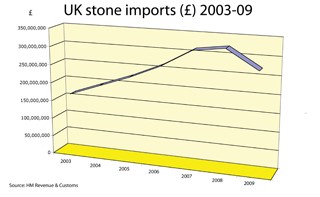
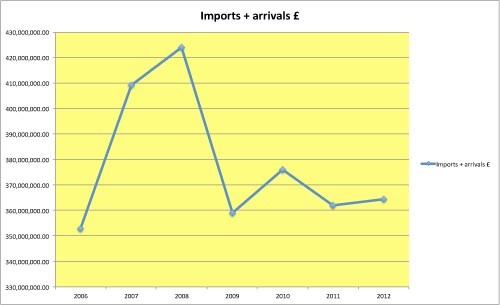
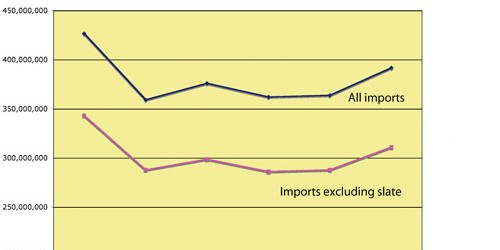
The only presumably reliable figures available about the size of the stone industry in the UK come from HM Revenue & Customs, and they often have peculiarities – although those peculiarities generally disappear over time as the figures are updated. The latest figures, for example, (from which the graphs above were compiled) show a 67% jump in the volume of imports in 2012 while the value went up about 3%. There could have been a big shift to lower value stone, possibly, for example, as the result of the use of a lot of imported stone hard landscaping for the Olympics and perhaps as a result of the Far Eastern companies that have established depots in the UK trading as Stone Yard, KSG (UK), Nile and others. Currency fluctuations also add their complications to comparisons of the value of imports measured in sterling. Nevertheless, experience suggests there could have been an inputting error in the figures that will be corrected in the months ahead. As HMRC tends to be more interested in money than quantities, the value of the imports is usually more reliable than the volume.

According to HMRC, there were £364million worth of dimensional stone imports last year (these figures are amended as the year progresses, but will probably not alter much now). That includes slate (much of which is for roofing) and hard landscaping products. It also includes memorials and excludes some of the stone that will have come into the UK recorded as a product rather than a material (furniture, for example).

If slate and hard landscaping products are removed from the figures (it is not possible to distinguish between stone used for memorials and architectural stone in the figures), the value of the imports left is £265million. Based on Natural Stone Specialist estimates of the value of the market for indigenous stone and the way both indigenous and imported stones are used, that is probably about 77% of the market for architectural and memorial stone (ie excluding slate and hard landscaping – and you can read more about hard landscaping here), leaving the indigenous suppliers with sales of about £80million last year and giving the architectural stone market a total value of around £345million in stone supply.

Once the stone has been sawn, shaped, finished and installed, it is worth considerably more. It is (again) difficult to make an easy calculation about the value added during processing because a piece of stone cropped for walling will have less added value than a polished slab turned into a kitchen worktop, which in turn will have less added value than a 5-tonne block of limestone worked into a Corinthian capital (at least, it appears to have, although when the finished price is divided by the number of hours involved in production, the worktop might look more expensive than the Corinthian capital).

Making an educated guess about the added value, the market at the client end is probably worth about £3,225million. There are around 4,000 companies involved in the various architectural stone markets and another 800 in memorial retailing, making the mean turnover in the sector £670,000 a year.

There were, until 2009, more companies in the kitchen worktop sector, which has suffered particularly badly from the downturn. According to some estimates, about 300 companies, a quarter of the sector, have closed down since the end of 2008 (although some of the directors and employees have subsequently reappeared with new companies, sometimes to the chagrin of their suppliers who have been left holding the debt).

The stone sector grew rapidly after the turn of the millennium on the back of the property bubble but some of the companies that came into the market latterly were too highly geared to be able to survive when demand fell. Others suffered a cash flow crisis when the banks withdrew their support in 2009. Others were able to ride the downturn for a while, but have not been able to survive on the reduced margins as the years have gone by. The slight upturn in stone sales in 2010 has proved to be a dead cat bounce and the market has been basically flat following the bursting of the bubble at the end of 2008. In the middle of 2013, processors going into receivership and leaving bad debts is still a problem for their suppliers.

So far, most of the wholesalers have survived – indeed, new companies have come into the market. Wholesalers of imported stone play a vital role in the distribution chain of the stone industry because there are so many different kinds of stone (and engineered stone alternatives that are also processed by the stone industry) from all over the world. The relatively small size of most processors seldom enables them to gain a price advantage from importing directly. And even if it did, most of them do not want to tie up cash in the amount of stock they need to hold in order to satisfy their customers.

In Ireland, infrastructure is the only light in the construction market as the Government tries to inject some life into economy.

Tough economic times have seen a decline across Ireland’s construction industry, but the infrastructure sector should record positive growth between 2013 and 2017, according to the Timetric report, Construction in Ireland – Key Trends and Opportunities to 2017.
 
Despite a significant decline in the Irish construction industry – a CAGR (compound annual growth rate – or, in this case, shrinkage rate) of -28.25% between 2008 and 2012 – infrastructure is projected to record a CAGR of 1% between 2013 and 2017. This growth can primarily be attributed to various transport plans and government initiatives that are seeking to stimulate the economy.
 
Depressed economic conditions as a result of austerity measures are making it difficult for Irish households to repay housing debt. Furthermore, prospective buyers – especially those taking their first steps on to the property ladder – are finding it difficult to secure mortgages without prohibitively large deposits. Consequently,and despite house building being the largest section of the construction market in Ireland (accounting for 34.7% of total construction output in 2012) it was also one of the worst performing between 2008 and 2012, recording a CAGR of -29.37%.

Customer spending in Ireland has been rendered cautious by high unemployment, low wage growth, and a depressed economic outlook. Combined with businesses’ fear of making large investments as a result of government spending cuts and tax hikes, this has had a significantly detrimental effect on Ireland’s commercial construction market, which has recorded the most significant decline of all sectors – a CAGR of -32.93% between 2008 and 2012.

In the industrial sector, uncertainty in the global economy has had a negative effect on Irish exports, affecting the manufacturing industry in particular. This, coupled with the more general economic malaise, saw the Irish industrial construction sector record a CAGR of -31.36% between 2008 and 2012 – the second largest decline of all Irish construction markets.

Although all sectors of Irish construction registered negative growth between 2008 and 2012, a low benchmark interest rate, various transport plans and government initiatives to stimulate the economy are expected to encourage growth in the infrastructure sector between 2013 and 2017.

For further information: Timetric’s report, ‘Construction in Ireland – Key Trends and Opportunities to 2017’ is available at: http://timetric.com/research/report/CN0132MR

Source: Natural Stone Specialist, the monthly magazine for the natural stone industry in the UK and Ireland since 1882

Source: Stone specialist

The UK stone market report January 2014 – part 3

part3

stéphane Couteaud, the area sales manager for French stone machinery manufacturer Thibaut, summed it up when he said: “What’s going on in the UK and Ireland is very positive. It’s the spark that I hope will ignite all Europe.” And what is going on in the UK (although not Ireland yet) is faster growth than anywhere else in Europe.

Sales of Thibaut (and all other) stone processing machinery in the UK have taken off again as the economy improves and stonemasonry companies need efficiency improvements to keep up with demand.

The UK economy is growing strongly across the board month on month, quarter on quarter, with construction leading the way as one of the largest industries in the UK employing more than 2million people in 250,000 businesses.

And all the predictions are for continued growth. Using a mixture of forecasts from Glenigan and the Construction Products Association as an indication of the growth of the stone industry in the years ahead shows a growth of nearly 20% between 2011 and 2017 (see graph). That will see sales of stone back above their 2008 peak.

And that might underestimate the growthe in the natural stone sector, which has been taking sales from other sectors since the mid-1990s.

Back in the early 1990s limestone and travertine floors were a rareity, especially in domestic property; granite and engineered quartz worktops only appeared at the highest end of the market; hard landscaping was predominantly concrete with some clay. Even though the best commercial buildings were clad in natural stone, many more of them are clad in stone now, with marble, granite and limestone in the public and private interior and toilet areas.

The Millennium gave clients and specifiers a longer-term perspective on their work and now customers have seen the quality and beauty of stone they do not want to go back to using other materials. There is no indication that the appreciation of stone is dwindling.

One of the drivers of the increased use of stone were falling prices as the Far East, in particular India and China, took a rapidly increasing share of the market. There are still those who want the distinctive quality of indigenous and European stones, but there are plenty more who like the economy of imports from further afield. The prices of those imports are now starting to rise – as a result of increasing wages and improved health & safety and environmental controls in the Far East and currency exchange rates as the Far East becomes richer.

Nevetheless, there is a still a huge difference between the price of stone from the Far East and the price of stone from Europe, including the British Isles.

Unable to compete with the low prices from the Far East, Italy, in particular, has striven to add value to its stone, with elaborate cutting and finishing – and with some success. Although the average price of stone from Italy last year was £952 a tonne, compared with £148 a tonne from the Far East, there are still those who want Italian style and quality of production and are prepared to pay for it.

And that is not only true in the UK. According to Internazionale Marmi e Macchina (IMM) Carrara, in January to September last year, Italian companies exported 3,214,718 tonnes of stone at a value of €1.4billion to the rest of the world. That is 3.2% more by volume and 7.2% more in value than in the same period in 2012.

The most significant area of growth was finished marble, with exports of 675,000 tonnes (+4.6%) worth €648.3million (+10.1%).

IMM Chairman Fabio Felici comments: “It is a trend that reinforces the first few months of the year and, more importantly, it is in contrast with the general trend of the economy – testifying to the international appreciation of Italian stone and the importance of the industry that creates employment and added value.”

In the UK, there are those who want to use British stones in particular because these stones are eminently appropriate in historic and sensitive settings… and some people also want to support local industry and people, especially in a recession.

In fact, British quarries in general have not suffered from the economic downturn as much as importers, not least because what has been built has tended to be at the higher end of the market by clients who are more sensitive about the materials they use… or who want to build in areas where planners are more sensitive about it.

With the UK economy growing and stone still a much sought after material in many sectors of construction, there is every indication that, as M Couteaud hoped, the UK will indeed be the spark to ignite the recovery of Europe.

The wider background to UK growth

Just look at the Glenigan* summary for 2013:

  • Glenigan Index for December 2013 up 15% year on year
  • Second consecutive quarter of growth in non-residential construction starts for the first time since 2010

  • Retail starts double the level during the final quarter of 2012
  • Civil engineering starts 41% higher than 2012
  • Education project starts up by 35%.

Figures from the UK Government published in January 2014 and relating to the period to November 2013 confirm this growth trend:

  • Construction output up 2.2% when comparing November 2013 with November 2012, the sixth consecutive month of year on year increase
  • 2% increase in new work and 0.6% increase in repair and maintenance
  • Three months to November up 5.1% on the previous year
  • New work up 5.3%
  • Repair & maintenance up 4.7%

The growth in housebuilding has been particularly pronounced. In the 12 months to October 2013, UK house prices increased 5.5% and in the first 11 months of 2013 (the latest figures available when this was written) public housing construction increased by 10.1% while private house construction grew 13.8 %. This is where stone floors and fireplaces, granite kitchen worktops, splashbacks and tiles, and marble and limestone bathrooms go.

The commercial private sector saw 11.5% growth in the three months to November compared with a year earlier. This produces stone’s major contracts – cladding, large areas of flooring and wall linings, reception areas, bathrooms.

In the 11 months to November last year, the stone industry had already imported more stone than it did in the whole of 2012 and was set for around 8% growth during the year.

It is no wonder the stone industry in the UK has had to invest in new machinery to meet the demand.

But it is not just new machinery that meets the growing demand. All that extra product has to be fixed onsite and growth in the construction industry rapidly translates to employment. Government figures in January showed not only that unemployment was falling but that the number of people employed in the UK has grown significantly.

The UK now has a more than 30million people working – up 485,000 from a year earlier – with unemployment down to 7.1%. The average number of hours worked has also returned to its pre-downturn peak.

Behind the figures lies a major improvement in confidence among Britain’s business community. The Confederation of British Industry (CBI), the UK’s leading business group, is forecasting GDP growth of 2.4% in 2014 rising to 2.6% in 2015, with domestic demand supported by increases in business and housing investment and household disposable income.

John Cridland, CBI Director-General, said: “The UK is now set fair for growth, with confidence returning to Britain’s entrepreneurs. The recovery that started in the service sector has fanned out to manufacturing and construction and is shaping up to be more broad-based.”

The CBI represents the largest of British industry, but small and medium sized enterprises (SMEs, in the jargon) are also felling confident. Vistage is a support organisation the owners and top executives of businesses. Its latest survey has revealed high levels of confidence as we enter 2014.

The Vistage Confidence Index show that 73% of small and medium sized businesses in the UK and Ireland expect the economy to improve this year and 80% are preparing for a significant surge in sales.

They felt 2013 was a much better year for the UK economy, with 76% reporting improved economic conditions compared with a year earlier. At the start of 2013 confidence was a lot lower with only 20% believing business was improving. This positive change in expectations will no doubt continue to contribute to sustainable improvements in the current economic climate, says Steve Gilroy, CEO of Vistage.

Steve Gilroy: “Germany’s medium-sized businesses are rightly feted as the reason for its economic success. By contrast, Britain’s mittelstand companies are the UK economy’s unsung heroes, despite their huge importance to a sustained recovery and sustained job-creation.”

With such a positive outlook for the coming months and years, business leaders are able to focus on making real investments in their businesses.

Steve: “Many [companies] have emerged from the economic malaise of recent years in good health and cash-rich. Our research shows they are expecting a good 2014 and most have active plans to expand their workforces to take advantage of this – in fact many are doing this already.”

*Glenigan is the provider of UK construction project sales leads, market analysis, forecasting, and company intelligence. Its clients include companies of all sizes at every stage of the construction cycle and it has strategic partnerships with The Builders’ Conference, BRE, UKCG, Constructing Excellence, CECA, HBF and GroundSure. Glenigan produces the construction industry Key Performance Indicators survey for ONS and BIS.

Source: Stone specialist

The market for stone in the UK first half 2014 – part 2


report September 2014…

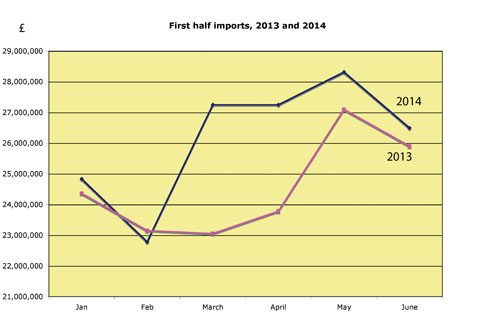
Imports of stone in the second quarter of 2014 continued to increase. They were up 10% on the first quarter of the year and 7% on the same quarter last year, according to figures from HM Revenue & Customs. For the first half of the year as a whole, imports were up 6% on the first half of 2013.

dd

The figures exclude slate, imports of which fell slightly – down 6% on the first quarter and 3% on the second quarter of 2013.


The figures are compiled from VAT returns, so continue to be amended for many months, although early trends are usually reinforced over time.

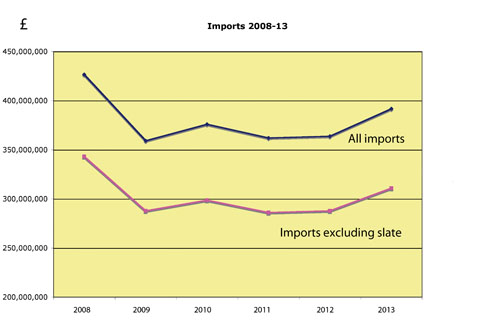
They also underestimate the market to some extent as some stone products are classified under other product codes. Nevertheless, they are compiled in the same way each period and identify trends. The current trend is clearly upwards, as the graphs here show.

There are no figures produced for British stone production, which probably now accounts for no more than a quarter of the market. However, according to the major operators of British quarries and mines, the trend is also upwards for indigenous stone sales.

dd1

Walling stone sales, which are predominantly British stone, had been badly hit by the drop in housebuilding, but some of the quarries that produce walling stone have reported that, while volumes are down, value has been supported by more masonry and architectural stone being used for larger houses and mansions. Because stone production in the UK is relatively small scale, it does not take many mansions to keep quarries and masons’ workshops busy.

The graph here showing annual stone imports since the height of the market in April 2008 identifies a classic ‘dead cat’ bounce in 2010. The fall in imports in 2009 was worsened by the withdrawal of funding arrangements to many companies by banks, which considerably worsened the impact of the banking crisis on the rest of the economy. 

It is estimated that about 300 stone companies in the UK were forced out of business – around 7.5% of the industry – many of them in the kitchen worktop market, a sector that was hit by the general fall in incomes and consumer confidence and the crash of housebuilding. 

For some, it was only a temporary absence from the market. Others have not returned. Those who remained had to reduce the level of stock held to bring it more in line with the lower level of demand. The effect was to reduce the import of stone below the general level of demand and produce the dead cat bounce in 2010 and the return to recession in 2011 as the market sought equilibrium.

Since then, many parts of the stone market have continued to reflect the improvement in the UK economy in general (the International Monetary Fund says the UK will easily have the highest level of growth in the developed world this year) as the increasing amount of stone being imported indicates.

Most of the stone arriving in the UK still comes from India, China and Italy, if you exclude slate. Slate accounts for much more than half the stone imports from Europe and most of it comes from Spain.

Most stone comes from India. The average price of the 281,500 tonnes of stone that was imported from India in the second quarter this year was £235. The average price of the 110,000tonnes of stone from China in the second quarter of this year was £311. And the average price of just under 16,000 tonnes from Italy was £897.

The figures are not exactly comparable because the products are not exactly the same. For example, quite a lot of sandstone for paving comes from India and sandstone paving is not as expensive as polished granite. Also, a fair amount of the granite from China is setts and kerbs, which are less expensive than polished slabs, while Italy sends a lot of added-value finished stone to the UK. Nevertheless, the trends are clear.


Source: Stone specialist


The growth of the stone market in the UK- part 1


The growth of the stone market in the UK

October 2015

The use of stone in the UK diminished with modern architecture in the first three quarters of the 20th century but has since enjoyed a major revival and demand for it continues to grow strongly as the UK recovers from the economic crash that started with the credit crunch of 2007-8.

Fashions change – most granite worktops installed are dark colours but gradually lighter and more lively colours are growing in popularity. Many would like marble in their kitchens but are put off because marble is easily stained and etched. The makers of engineered quartz are capitalising on this by making products that look more like light-coloured marble but with the strength of granite. Many stone companies supplying worktops these days find half or more of their sales come from quartz.

As the UK construction industry continues to grow out of the recession demand for stone continues to strengthen. The use of stone is now well re-established in all areas of construction – commercial and domestic, for cladding and walling, flooring, worktops, wall coverings, features such as fireplaces and attention grabbing stairs (especially cantilevered stairs and landings).

Hard landscaping has also turned to stone in a major way, both for public and private projects. In 1980 stone paving and walling was a rareity. Now it is only a question of which stone to use. The big change was a huge increase in sandstone from India (in particular) and granite from China (in particular). The low price of these products, coinciding with a growing awareness of the importance of the spaces between buildings and an explosion of major urban regeneration programmes, brought about a sea change in the aesthetic for urban spaces. A driver has been the appreciation local administrations that simply improving the urban landscape can act as an impetus to a lot of private sector in the buildings in an area. This has been the rationale for a lot of urban landscape projects.

Britain and Ireland have a long history of building with stone, with monuments still standing that date back to pre-history – the most famous of which is probably Stone Henge on Salisbury Plain in the south of England, although others, notably Skara Brae in Scotland and New Grange, in Ireland are more impressive to visit.

The Roman conquest and 400-year occupation of Britain left us with stone fortifications and mansions. The Norman invasion of 1066 brought a burst of castle and church building, although it had begun before William the Conqueror turned up at Hastings as religious orders established their cathedrals and monastries across the land.

Stone has always been chosen for structures that are intended to show solidity and permanence, marking out the finest in architecture through the centuries.

With the rise of modernism at the start of the 19th century, architects turned to the then newly developed hard concretes, but as the second millennium drew to a close, architecture in Britain rediscovered its love of stone. Once again, the very symbol of permanence and longevity was chosen to mark out significant buildings and landscapes intended to give the impression of being intended to last for the next 1,000 years. The UK Government made £5billion available to help pay for millenium projects, giving the economy a boost into the third millennium.

Stone continues to be popular. Inevitably sales fell as a result of the world credit crunch and economic crisis of 2007-8.

Between 2008 and 2009, GDP per head in the UK dropped by 5.5%, the largest annual decrease since 1949, another period of austerity. The number of houses being built more than halved and banks withdrew their support for many businesses. The value of stone imports fell 16% in 2009 from what, taken over the long term, now looks like the bubble of 2007-8.

Before the crash there had been a big increase in the number of companies moving into the production and installation of granite kitchen worktops. By 2009, when the economic downturn really hit, there were about 1,200 companies templating, making and installing worktops and the crash saw about a quarter of them go out of business as demand rapidly fell.

Prompted by lifestyle magazine articles and television programmes, granite and, later, engineered quartz worktops had become de rigueur. New builds and home improvements alike just had to have granite worktops. Limestone floors also became popular, as well as stone and marble features such as fireplaces. More recently, stone and marble walls, floors and vanity units have become popular for bathrooms and wet rooms, and stone is more frequently seen in bedrooms and living areas.

In commercial buildings, the City of London leads the way in the use of stone for cladding and masonry on its offices, and stone and marble in its interiors, especially in public areas of foyers and toilets. But all major cities aspire to have stone marking their centres of administration, commerce and entertainment.

Many contractors still turn to Italy as a centre of stone selection and source for major projects in the UK, although Spain, Germany and France also supply cladding and masonry for new build and conservation projects in the UK and, of course, the British Isles produce their own stones, although they only account for about 25% of the market these days.

While larger stone contractors such as Szerelmey, PAYE, Stonewest, Livra, APS, Vetter, Mather & Ellis, Ketton, William Anelay and many more, as well as major interiors stone do buy their stone directly from suppliers all over the world, the recession made companies think again about holding expensive stock and more returned to the traditional supply chain of established international and national wholesalers such as Pisani, Levantina, The Marble & Granite Centre, Gerald Culliford, Beltrami, B-Stone, MGLW, Cosentino, International Stones and many others, as well as specialists in hard landscaping, roofing and memorials. They are all listed with full contact details in the Natural Stone Directory, which can be bought online from www.naturalstonespecialist.com/directory.

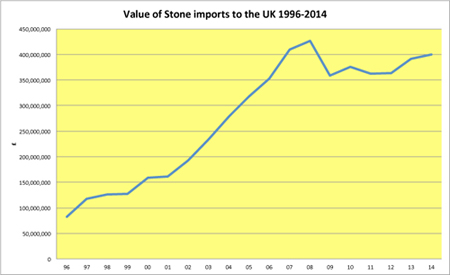
After the crash of 2009 there was a dead cat bounce in 2010, and adjustment back down in 2011 and each of the three completed years since then have seen stone imports growing again, with volume outpacing value, reflecting the strength of sterling and, perhaps, a hardening of attitudes by buyers.

According to the figures from HM Revenue & Customs, the value of imports in 2014 grew a little more than 2% to just over £400million for nearly 3million tonnes of stone. Figures for UK stone production (mostly limestone and sandstone and a little granite) are sketchy. However, according to the British Geological Survey, UK production was a little under 1million tonnes, which the Minerals Products Association’s Dimension Stone Group values at about £350million.

An upward trend in the market is clear, reflecting both the growth in British construction (up 7.4% in 2014) and the economy in general (up 2.8%).

Direct imports from India and China continue to grow and for the first time last year the two countries supplied more than half the UK’s stone imports. India still supplies most (nearly £127million worth last year) but China’s contribution was up 5% at just over £74million.

From Europe, Spain has maintained its position as the UK’s major supplier, not least because it ships a lot of roofing slate to Britain as well as granite for hard landscaping. In 2014 it was the source of 138,000tonnes of natural stone products valued at £58million.

Italy’s importance as a supplier to the UK has been diminishing, slowly but inexorably, for many years. At the height of the market in 2008 it shipped 51,000tonnes of stone to the UK valued in sterling at £52million. Last year that was 31,000tonnes worth £30million, according to MH Revenue & Customs.

Italy is still respected for its high quality finished stone and many developers continue to turn to Italy to source large quantities of natural materials for top-of-the-market projects, but clearly alternative sources are also being used.

  • The usual caveats apply to these figures: they are based on VAT returns and some products can slip through under different product categories, so do not show up as stone imports. No doubt some stone that would not normally be considered part of the stonemason’s repertoire is also included. Nevetheless, the figures are comparable over time and provide the best source of information available to the industry about trends in the use of natural stone.
  • No independent value is reported for the indigenous stone industry in the UK, which has about 170 quarry and mine operators supplying dimensional stone extracted from about 250 quarries and mines in the British Isles. The stone is used almost exclusively for the home market, although a little goes overseas.


UK stone market continues to grow

June 2015

For the third successive year, the UK’s imports of stone for construction and memorials grew again in 2014. Volume growth once again outpaced the growth in the value of them, reflecting the strength of sterling and, perhaps, a hardening of attitudes by buyers.

According to the figures from HM Revenue & Customs, the value of imports last year grew a little more than 2% to just over £400million while the volume was up 37% at nearly 3million tonnes. According to the British Geological Survey, UK production was a little under 1million tonnes, which the Minerals Products Association’s Dimension Stone Group values at about £350million.

Because the stone sector is fairly small, fluctuations in prices and volumes are quite large because they can be influenced by a small number of projects. Nevertheless, an upward trend in the market is clear, reflecting both the growth in British construction (up 7.4% in 2014) and the economy in general (up 2.8%).

Direct imports from India and China continue to grow and for the first time last year the two countries supplied more than half the UK’s stone imports. India still supplies most (nearly £127million worth last year) but China’s contribution was up 5% at just over £74million.

Imports from South Korea are increasing – it supplied 2,000tonnes in 2014 worth £2million, making its price per tonne about the same as stone from Italy. More is coming directly from Latin America (2014 = 36,000tonnes valued at £12million). There is an increasing amount from the Middle East and North Africa (2014 = 17,500 tonnes valued at £10million).

From Europe, Spain has maintained its position as the UK’s major supplier, not least because it ships a lot of roofing slate to Britain as well as granite for hard landscaping. In 2014 it was the source of 138,000tonnes of natural stone products valued at £58million.

Italy is Europe’s largest stone trading nation but its importance as a supplier to the UK has been diminishing, slowly but inexorably, for many years. At the height of the market in 2008 it shipped 51,000tonnes of stone to the UK valued in sterling at £52million. Last year that was 31,000tonnes worth £30million.

Italy is still respected for its high quality finished stone and many developers continue to turn to Italy to source large quantities of natural materials for top-of-the-market projects, but clearly alternative sources are also being used.

·         The usual caveats apply to these figures: they are based on VAT returns and some products can slip through under different product categories, so do not show up as stone imports. No doubt some stone that would not normally be considered part of the stonemason’s repertoire is also included. Nevetheless, the figures are comparable over time and provide the best source of information available to the industry about trends in the use of natural stone. Also the figures continue to be amended for many months after they first appear.
·         No independent value is reported for the indigenous stone industry in the UK, which has about 170 quarry and mine operators supplying dimensional stone extracted from about 250 quarries and mines in the British Isles. The stone is used almost exclusively for the home market, although a little goes overseas. More Irish stone is exported, especially the Irish Blue limestone that goes to the Netherlands and Belgium, where it is used as a match for the Belgian Blue (Petit Granite).


Source: Stone specialist
How to choose natural stone for projects?

Rogerio Moutinho, MGLW (United Kingdom)

What do architects and designers really look for, when they want to use natural stone?

Without trying to be too simplistic, what one really wants when choosing natural stone for a project is:

1.- A stone with the right colour and pattern

2.- A stone that is suitable or adequate for the purpose, i.e., it is hard enough,not too absorbent, etc.

3.- That the natural stone is fairly easily available, i.e., in the quantity that one requires, and is so within the time frame of the project.

4.- Finally, a natural stone that is affordable or basically that which is within the budget originally allocated. 
 

But before we get into more detail regarding these four points let us also ask ourselves the following question: What comes to your mind when you hear the word NATURAL STONE?

Do you see DESIGN and DECORATION – because you saw a beautiful entrance hall in a hotel, or a showroom with a fine-looking worktop, or even a striking shower cubicle with some exquisitely book-matched veined slabs of an exotic material?

Do you also see ART – the many beautiful sculptures, be antique or modern, are you are able to enjoy as you walk around a city or when visiting a monument?

Do you see it as a BUILDING MATERIAL – how often, as architects or designers, have you stopped to admire a beautiful façade, a rustic wall, a shop-front with a special finish?

Finally, do you see natural stone as HISTORY – nobody can deny that natural stone is an integral part of our heritage. The evidence is there to be seen in every country. As one of the most durable materials, natural stone has always been used for structures (from the pyramids of Egypt to just about any old building in any city), and they are a living testimony of human history.

Because of all these values that it encapsulates, natural stone is really a material like no other.

Now, stone is a natural product, and, as such, it has its own particularities, which means that we must make carefully informed decisions when choosing one for a project. But, going back to the topic – what are the criteria one should take into account when choosing natural stone for a project?

One good method is to make a CHECK LIST that summarises the main criteria. Of course, each point can include many variables depending on the particular situation, but the most important ones are covered here and are valid for most of them.

All these points in the CHECK LIST are all crucial, and they are listed below in no particular order.

1.- Commercial or domestic use

2.- Internal or external application

3.- Special finish requirements

4.- Colour scheme and book matching

5.-Quantity required versus availability

6.- Sampling and viewing the stone in LARGE slabs

7.- Budget

8.- Technical data or tests

Although these are quite self-explanatory, let us go into some detail about each of them.

1.- Commercial or domestic use:

Commercial use implies heavier traffic, which requires a harder-wearing stone. One should not use a soft limestone, no matter how great it looks, on a shopping centre floor, but one can use it for the walls.

On the contrary, for domestic use one has, in theory, the whole array of natural stones to choose from, depending on the purpose: for example, for a kitchen countertop, the best choice remains granite, because its chemical composition makes it less susceptible to staining from acid corrosion.

2.- Internal or external application

With regard to internal use, the only limitations are those we have already looked at.

When it comes to natural stone for external use, the first thing to bear in mind is: is it for wall cladding, or is it for flooring? Most stones are suitable for cladding because water just runs down the walls, but, nevertheless, one should take into consideration the technical data of the stone. For example, the absorption data should be considered. Nowadays, there is a test called ‘salt crystallisation’ which gives one an idea of how the stone will age and wear over time.

As for external flooring, weather factors play an even bigger role. Water, snow and ice (depending on the climate of the place), will remain on the surface and will have a much greater interaction with the stone. In my experience, external flooring in cold climates requires stones which meet the highest specifications.

3.- Special finish requirements

For safety reasons, projects often require a special non-slip surface. In many cases, this implies applying a special finish such as flaming, bush-hammering or sandblasting. But bear in mind that some of these finishes cannot be applied to all the stones.For instance, flaming is out of the question in the majority of limestones.

4.- Colour scheme and book matching

There is always a natural stone for almost every colour scheme in anyone’s project. Stone is a natural product, it comes from a quarry, not a factory line producing perfectly evenly coloured pieces. This natural colour variation makes it unique and gives it its beauty. The issue here is- quantity versus uniformity. If the project is for a large area, one may want to restrict oneself to stones that are naturally more uniform. Additionally, one should be aware of the great potential for effect of book-matching with veined materials (image book-matched material) This can make one´s project really unique because there will be no other set of slabs in the world with the exact same pattern.

5.- Quantity required versus availability

It seems obvious, but many people are often surprised at how often problems arise because of unreasonable expectations around two aspects:

Of any given stone, there are slabs that are more figured and others that are less figured. If one goes for a perfectly clean look, for a larger area, it might be impossible to achieve the required quantity. Nobody will dig out half a mountain to make your dining-room floor.

On the other hand, even without this sort of limitation, when one deals with mega-projects, one must make sure beforehand that the quarry has the capacity to extract the quantity of material required within the required timescale.

6.- Sampling and viewing the stone in LARGE slabs

Continuing from the previous point, it is imperative that one does not make the final decision on using a natural stone based just on a sample. This is, in my opinion, one of the most common mistakes made in the stone industry. Whenever possible, it is highly recommendable to visit the local distributor and see for oneself the large slabs that will give one a much more realistic idea of what the stone will look like in a bigger area, be it flooring, a façade, etc. High quality photographs of slabs can also been seen on the tablets as an alternative, when a personal visit is not possible.

7.- Budget

This is obviously the most self-explanatory point of any check-list. However, it must be said that there is almost always a natural stone for every budget.

8.- Technical data or test

Depending on the project that one is working on, it is important to be aware that quarries are increasingly producing technical data sheets for each type of material, based on lab tests. Since July, 2013 the European Union has making it compulsory for quarries to supply this information.

To sum up, natural stone can add a unique value to a project, it just requires choosing wisely. Please make the most of the knowledge and experience built up over the years by your distributor / natural stone supplier. Visit them, talk to them, feel the natural stone, ask all the questions, no matter how simple they might seem. And if there is a particularly complicated requirement, your stone supplier is there to get for you all the answers directly from the quarries.

A project in natural stone highlights the uniqueness of not just the stone, but of the whole project itself. Make the choice the proper way- and you will be even more proud of what you have built.

Published in LITOS 118, September 2013

Source : litosonline