All posts by Soheil

Since more than 20 years, the owner and general manager of TexaStone Quarries has played an active role in countless industry initiatives

Brenda Edwards, owner and general manager of TexaStone Quarries in Garden City, TX, is the recipient of the first-ever Women in Stone Pioneer Award. Edwards received the award at the MIA+BSI Awards Luncheon at TISE fair in Las Vegas in January.

In a career spanning more than 20 years, Edwards has been an active participant in countless industry initiatives and associations. She has held key leadership roles with Marble Insitute of America (MIA), Busilding Stone Institute (BSI), and the Natural Stone Council, and is currently serving on the transitional MIA+BSI Board of Directors. Her company was the first to certify under the ANSI/NSC 373 Sustainability Standard, and her leadership was paramount to the creation of the Women in Stone initiative.

In a letter nominating Edwards for this award, Jennifer Sayles, Marketing Manager at TexaStone Quarries wrote: „Brenda teaches anyone that wants to learn, helps anyone in need, battles any obstacle that comes her way, and loves this industry fiercely. Her passion is contagious; her knowledge immeasurable. Brenda is truly a pioneer for this industry.”

Brie Pfannenbecker, VP of Operations at Connecticut Stone, agrees: „Brenda’s impact spans both genders and ensures a brighter, more competent, more dynamic future for the industry as a whole.”

Edwards reflects on her involvement with Women in Stone and how it has impacted her career: „In all my years in the stone industry, I have never had more fun and appreciated the business more than being involved with Women in Stone. I am honored to serve with these intelligent, energetic, and passionate ladies. Together they have brought recognition to the women working in the stone industry. A special thanks to MIA+BSI for making it all possible and giving me the opportunity to serve with each one of them!”


Source: Stone-idea

Amongst beginning of Russia stone industry exhibition, an stone expert considered

Amongst beginning of Russia stone industry exhibition, an stone expert considered:

Stone market success depends on government support and preferential tariff

The price of transportation affects prime cost of stone; because of that one of neighbor countries should be determined as a target market.

Mohammad Rasa said: Stone is one of the mineral fields in Iran with the most capacity for global scale development and competition. Nevertheless, still there is not much success and Iran has given the important markets over to small and unknown competitors. However, the entrance opportunity has been prepared in Russia as the first chain of globalization of Iran stone reputation.

Youstone executive director (Service and Consulting Iran Stone Company), Mohammad Rasa, in an interview with “Samt” declared: Although, the Russia market has been located close to Iran, it was not considered by internal Iranian companies. It’s because of success in internal market and followed by at least in two last years any Iranian companies did not participate in Moscow stone exhibition.

Russia, stone target market

Rasa said: One reason for the importance of Russia market is its proximity to Iran’s borders. Another reason is huge Russia stone market. Russia with abundant population and appropriate economic situation is a country which can have significant imports.

According to demographic and economic specification of Russia, this country can be a suitable market for Iran luxury stones and it can prepare the market for ordinary and cheaper Iranian stones, as well.

The challenge of entry to the Russia Market

Rasa noticed about different difficulties of entry to Russia market. He said: As food industry has problems to enter Russia profitable market, stone industry also cannot enter to this market easily. One of these obstacles has been strong penetration to Russia. Rasa mentioned: Iran Stone Association and stone industry activists have done an unprecedented action. Meanwhile they declared their presentation in Moscow stone industry exhibition, they concluded to be present with an equal shape, unit strategy and same pavilions.

Unreached expectations from government

Rasa said: 9 to 10 Iranian companies’ participation in Moscow stone industry is not enough. More than this number was expected but unfortunately it was not possible because of high price in international exhibitions.

Youstone executive director said: The government could have an effective role in supporting of Iranian companies in Moscow stone exhibition, but it did not happen.

It is expected at least 50 percent of stone industry costs be provided by the government.

Stone requires Full government support

Youstone executive director continued: Iran stone quarries are located in outlying and excluded places. On the other hand, this field creates high value added and high revenue for the country. He said: If the government supports stone industry, it will be profitable and foreign exchange inflow market. To achieve these goals, the government should facilitate exports, and like as Turkey, request Russia to adopt the preferential tariff for stone exporting.

Number of participated countries in Moscow stone exhibition during last years

Some of participated countries 2014 2015 2016
Russia 136 122 123
China 67 38 36
Turkey 17 19
Italy 30 25 28
India 4 7 5
Iran 0 0 14

Quartz and white marble remain growing trends of kitchen design

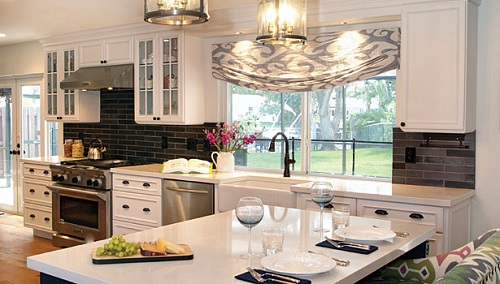
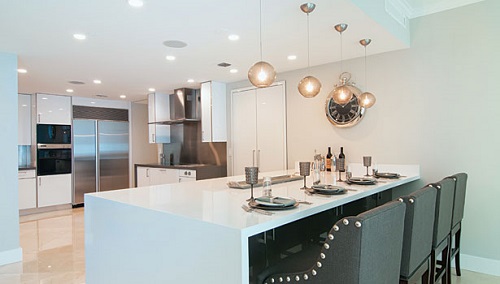
When it comes to the kitchen — the most popular space in any residence — quartz and white marble remain growing trends, while mitered corners are also often requested for countertops

When it comes to aesthetics, homeowners are usually looking to incorporate what’s trending and what’s “hot” on the market to make each space unique.

When speaking with fabricators along the East Coast, it’s apparent that granite is not the only popular choice for countertops anymore. “Everyone wants white marble,” said Tim Farr, owner of StoneWorks in Augusta, Inc. in Augusta, GA. “It’s just really popular. We see some quartz, but for the most part, it’s everything light and white. People are moving away from the staple colors to the whites.”

ys (1)

Marco Duran, co-owner of Atlas Marble & Granite in Springfield, NJ, also is seeing a trend towards marble countertops. “The most popular [materials] right now are marble or quartzite,” he said. “On a scale from one to three, with one being the most popular, I’d say marble is at one, with second, being quartzite. I think marble is the most popular only because people are not really aware of quartzite.

As an interior designer, Alena Capra, CKD, CBD of Alena Capra Designs in Fort Lauderdale, FL, said she has been working with a tremendous amount of white quartz lately. “I’ve done work in New York City as well as Florida, and more people are very much looking to do neutral quartz counters,” she said.

Anna Marie Fanelli, designer and vice president of Floor & Decor in Tenafly, NJ, echoed Capra’s comments and said her clientele is also requesting a lot of quartz to use for their homes. “I’ve introduced them to Dekton [by Cosentino], an ultra-compact material composed of glass and porcelain and the highest quality quartz material that can go on the inside and outside of buildings,” she said. “It comes in monochromatic colors — blacks and different types of whites. The technology is crazy; it’s amazing. I’ve used it for fireplaces, kitchens and bathrooms.

ys (2)

Selecting the right edge

When it comes to edges, the mitered edge has been growing in popularity, but for some areas of the country, it has already been around for a handful of years. “We took an interest in that maybe four to five years ago,” said Duran. “I just always like that look of miters and clean lines. From a personal standpoint, I want to impose that in our showroom. Pretty much, it’s more of a foresight in people’s minds. I was ahead of the trend when it came to miters in natural stone. We partook in mitering way before people took an interest in it. Now that there’s an interest in it, it’s like second nature to us. If you look at people who are trending, their choices are directed towards quartzite or stones, and those are complemented by mitered edges.”

Farr agrees that his shop is seeing more of the mitered edge. “It’s coming, I will tell you”, said Farr “If folks are not prepared, they better start to [get prepared]. [But], I think it’s just a trend. That’s part of the reason for us buying a new CNC saw — it’s more efficient. Our old saw didn’t miter, and this one does. It makes it simple.”

ys (3)

Polished verses honed

While many people tend to veer towards a polished finish, which is highly reflective, displaying the vibrancy and character of the stone’s natural colors, it really depends on the type of material being used and its application. “If I’m working with marble, it’s most likely honed,” said Farr. “There are some people that want the polished look. I’d say it’s probably a 70 to 30 ratio. About 70% want a honed finish and 30% want a polished finish.”

Duran said most of his customers are looking for the same things. “Honing is advantageous to having marble — people will drift towards honed tops,” he said. “If it’s marble, I’m almost positive they’re going for a honed finish; there’s probably a 3-to-1 ratio they’re selecting honed over polished. The polished finish — people are going just for the look of it.”

According to Fanelli, she believes the two finishes are equally popular. “It was always honed, but now it’s 50/50,” she said. “I’ve even done polished materials in the kitchen in porcelain. Before it was honed, honed, and honed. Now, it’s a combination of both.”

From Capra’s standpoint, she’s seeing the opposite, with the polished trend standing strong. “In this case, I am finding the tradition that kind of stays, for the most part, is polished countertops,” she said. “Not a lot of people are doing honed countertops. They keep trying the honed trend, but I don’t think it is happening. A shiny piece of stone in your kitchen contrasts so nicely. Most cabinets are wood, so I think it creates a beautiful, stunning contrast to have that polished top. I really don’t get asked for honed as much as I do for polished.

ys (4)

The future of stone

A couple of years ago, people were really looking for ways to save on stone products, while also being able to accomplish an upscale design. Today, the trend has totally shifted. Now, instead of worrying about cost, people are starting to indulge in the luxury items they really want, looking at it as an investment.

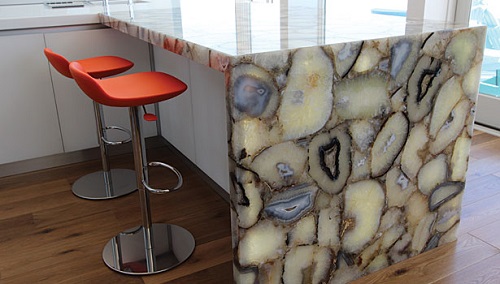
“The future is in semi-precious stones and the ultra-high-end market,” said Duran. “The luxury goods market is basically coming out of its shell. We’ve been predicting that for about a year now that there is a call now for a luxury product that is beyond white marble, exotic granite and engineered stone. We feel that luxury is coming back. People, again, are sort of having what they desire, instead of what is common. Granite is attainable and common — and people are looking for opulence and luxury — and that’s what is with a semi-precious collection. It’s got qualities that make it look so unique — as unique as the individual wants to be. People say, ‘This is what makes me different — having this surface. Not everyone can afford it.’ And that market is starting to bloom. It’s becoming fashionable.”

“What I’m seeing with kitchen backsplashes are a lot of stone with mirror, stone with gold, stone with platinum — a lot of mixing with exotic materials,” said Fanelli. It’s different these days; they have upscale feelings. People are saying to me, ‘The Kardashians did it,’ so you have this mindset of ‘the celebrities did it, now I can do it.’ It’s an interesting way of looking at it. If they have to spend $4,000 to $5,000, they will now. They’ll say it’s an investment; before, it was ridiculous, now it’s artwork, a specialty.”

Heather Fiore, associate editor of TILE Magazine

www.stoneworld.com

BUSINESS PROGRAM of STONE INDUSTRY -2016- Moscow

BUSINESS PROGRAM of STONE INDUSTRY -2016- Moscow

21– 24 June

(during the Exhibition working hours)

Stand A26

MASTER CLASS ON MANUFACTURING OF ARTWORKS OUT OF NATURAL STONE.

Organizer: Transbaikal Minerals Co.

21 June

Hall А, Presentation zone

1:00 p.m. – 2:00 p.m. Seminar: Natural stone market of Russia: development over the last 25 years, current state and prospects.

Organizer:

Stone & business publishing house


Speaker: S.V. Pavlova, Chief-editor of Stone & business magazine

«SCIENCE IN THE SERVICE OF PRODUCTION»

Research & Application Conference

Organizer: Mining institute (within Moscow Institute of Steel and Alloys National Research Technological University)

2.00 p.m.– 2.30p.m. Speaker:D. V. Pastikhin, Professor

Training of specialists in the field of dimensional stone quarrying in the Mining University

2.30 p.m.– 3.00 p.m. Speaker:E.B. Chepezkaya, Dr.Sc. (Engineering)

Investigation of micro-cracks of natural stone by nondestructive testing methods

3.00 p.m.– 3.30 p.m. Speaker: Yu.A. Pavlov, Dr.Sc. (Engineering)

Application of robotic engineering in the stone processing

3.30 p.m.– 4.00 p.m. Speaker: Zh. A. Kazaryan, Cand. Sc. (Engineering)

Application of European technologies in the stone industry of Russia: problems and prospects

4.00 p.m.– 4.30 p.m. Speaker: V.A. Tulnin, Dr.Sc. (Chemistry)

Protective magnesium-base coulored natural stone coatings of construction products

4.30 p.m. – 5.00 p.m. Speaker: V.A. Tulnin, Dr.Sc. (Chemistry)

A.A. Zakharova, Postgraduate

Application of coloured crystallites in production of decorative items

June 22

Hall А,Presentation area

PRESENTATION FORUM


11:00 a.m. – 11:40 a.m. Tunisian marble: discover the potential

Dreamland, Tunisia

AbdelmalekGhannem,General manager

11:40 a.m.– 12:20 p.m. Mine management company Vozrozhdenije Ltd – presentation of activity

Mine management company Vozrozhdenije Ltd, Russia

Michael Seleznev, Deputy General Director for Marketing & Promotion

12:20 p.m. – 1:00 p.m. Potentials of Iran Stone Industry

Stone association of Iran

Jafar Baradaran, Vice president of Export Commission

1:00 p.m. – 1.40 p.m. Innovations in stone processing: machinery, tools and chemicals

Company Almir, OOO

Maxim Kazakov, Technical consultant

1:40 p.m. – 2:00 p.m. Lunch break
2:00 p.m. – 2:40 p.m. Stone processing in Ural Region

Kamnerez LLC, Russia

Dmitry Selnitsin, Director

2:40 p.m. – 3:20 p.m. Introduction of Iran and Iranian Natural Stones

MGT (Marjan Golden Trading), Iran

Ebrahim Mirzaei, General Manager

3:20 p.m. – 4:00 p.m. Natural stone of Egypt

Presentation of companies – participants of the National Pavilion of Egypt

4:00 p.m. – 6:00 p.m. Cooperation of Russia and Iran in natural stone industry.Prospects of Iranian companies at the Russian market. Foundation of tradingplatform for Iranian goods out of natural stone in Russia. Presentation ofcompanies and their products.

Speakers: Zolali Parviz, ALVAND LTD, General director

Mohamad Hashemi, MGS Сo,General director

Ali Tavakoliyan,Arvin – Iranian granite Company, Director

June 23

Hall А, Presentation area

ARCHITECTS’ AND DESIGNERS’ MASTER CLASSES

on application of natural stone in interior and exterior design

10.00 am – 11.00 am Seminar: Stone in interior – installation technology. Difficulties and typical mistakes

Organizer:

ArchDialogue Communication and PR agency

11.00 am – 12.00 Seminar: Interesting ideas for interiors decoration. Creative approach and art-objects

Organizer:

ArchDialogue Communication and PR agency

12.00 – 1.00 pm Seminar: Designer and supplier. Particularities of cooperation and criteria of choice

Organizer:

ArchDialogue Communication andPRagency

1.00 pm – 2.00 pm Seminar Interiors in minimalism style. Difficulties of design and typical mistakes

Organizer:

ArchDialogue Communication and PR agency

2.00 pm – 3.00 pm Seminar: Application of natural and artificial stone in modern interiors

Organizers:

KASHUBA DESIGN International interior and architectural bureau

«House & Interior» magazine

Speakers:

V. Kashuba, member of the Moscow Union of Architects, winner of A.L. Chizhevsky academic prize in the field of interior design art and architecture

E. Vorobiev, professor, founder of «House & Interior» magazine

N. Sergeev, Head of department of facades out of natural stone of StoneWealth Management company

3.00 pm – 4.00 pm Seminar: Application of natural stone in exteriors

Organizer:

ARTPLANNER group of companies

Speaker:

А. Yagubyanz, founder of ARTPLANNER group of companies, member of the Union of Architects of Russia, permanent participant of TV-programs on home design and renovation.

4:00 pm – 5:00 pm Seminar: Problems of import of natural stone to Russia

Organizers:

KASHUBA DESIGN International interior and architectural bureau

StoneWealth Management company

«PRO Interior. Design & Decor» magazine

Speakers:

V.Kashuba, member of the Moscow Union of Architects, winner of A.L. Chizhevsky academic prize in the field of interior design art and architecture

D. Maksimov, General Director of Stone Wealth Management company

I. Koloskova, Chief Editor of «РRO Interior» magazine


Exhibitors list of Moscow Stone industry 2016

Exhibitors 2016 :


Abkhazia :


NEDRARESOURS, LLC part-time participation


Armenia:


ANDSTONE,LLC F06

KARASTGH, LLC C16

ORIENT STONE, LLC D04-E03

Belarus

GONCHARIK, PE H10

SANKY F03


Czechia:


GESTRA CZ s.r.o. H07


China:


AGA MACHINERY LTD B30

BEIJING STARS STONE CO., LTD C24-D25

BEST CHEER (XIAMEN) STONE WORKS CO., LTD E14

CCPIT BUILDING MATERIALS SUB-COUNCIL part-time participation

CHANGSHA TOOLSTAR MACHINERY MANUFACTURING CO., LTD C31

EZHOU BENEFIT DIAMOND TOOLS CO., LTD B15

FUDING BASALT STONE CO., LTD D29

FUJIAN HUANGCHANG GRINDING STONE ELECTRICAL CO., LTD B28-C27

FUJIAN HERUN STONE CO., LTD B14-C13

FUJIAN JINJIANG XIANDA MACHINERY CO., LTD D23

FUJIAN QUANZHOU HUAZUAN DIAMOND TOOLS CO., LTD C35

FUJIAN TIANLI GRINDING TOOLS MANUFACTURE CO., LTD F17.1

FUZHOU FICINA INDUSTRY & TRADING CO., LTD C30-D31

HAVSUN STONE A16-B11

HUADA SUPERABRASIVE TOOL TECHNOLOGY CO., LTD C33

HUBEI EXIN DIAMOND TECHNOLOGY CO., LTD B22-C21

JIANGXI XINGUANG DIAMOND TOOLS CO., LTD C19

JIANGXI ZHONGLI SUPERHARD MATERIAL TOOLS CO., LTD C26-D27

MING DIAMOND TOOLS CO., LIMITED B24-C23

QINGDAO HAISEN STONE CO., LTD B17

QUANZHOU HANSTONE NEW MATERIAL TECHNOLOGY CO., LTD B34

QUANZHOU SANG DIAMOND TOOLS CO., LTD E16

QUANZHOU SHUANGYANG DIAMOND TOOL CO., LTD B36

QUANZHOU XTAR DIAMOND TOOLS CO., LTD./FULLUX ABRASIVES C28

QUANZHOU YNS IMP. & EXP. CO., LTD F17

QUANZHOU ZHONGZHI DIAMOND TOOL CO., LTD C18-D19

SANSO SUPERHARD TOOLS CO., LTD C22

SHANDONG GOLD RHINO HUAXING MACHINERY CO., LTD A18

SHANXI SHIXINYUAN TRADING CO., LTD C20-D21

XIAMEN EASTERN PEGASUS CO., LTD B18

XIAMEN GREAT BASE CO., LTD C29

XIAMEN GYYSTONE IMP. & EXP. CO., LTD B13

XIAMEN TENGMAI IMPORT & EXPORT CO., LTD B32

XIAMEN YANGCHENG IMP. & EXP. CO., LTD B16-C15

YANTAI DIANY SAW MFG. CO. LTD F15

ZHAOYUAN HONGWEI STONE B20


Germany:


AMT JÄGGLE GMBH B02

HUMMEL GMBH/ANTE ANLAGEN TECHNIK B02


Egypt:


ABDEEN STONE FOR MARBLE & GRANITE G26

AL ABBAS FOR MARBLE & GRANITE H24

AL GAZEERA FOR MARBLE & GRANITE G22

ALEX TILES & ALEX MARMO FOR MARBLE & QUARRIES G24-H27

ALSAFA MARBLE FOR MARBLE & GRANITE F22-G21

CRYSTAL FOR MARBLE &GRANITE H28

ECKO STONE MARBLE H30

ECO EGYPT GROUP FOR MARBLE AND GRANITE G18-H19

EGYPT MOSAIC G17-H15

EGYPT STONES FOR MARBLE & GRANITE G16-H17

KR-ONYX H29

MISR EL NOUR H25

NILE SONS EGYPT FOR MARBLE & GRANITE G20-H21

NOOR EAST CO FOR MARBLE AND GRANITE F20-G19

ROYAL CREAM MARBLE H26

SARHAN FOR MARBLE AND GRANITE F18-G17

TRUST MARMAR F24-G23


India:


FEDERATION OF INDIAN CHAMBERS OF COMMERCE & INDUSTRY (FICCI) G05

JBB ENTERPRISES INDIA E08

MULTIWYN INTERNATIONAL PVT. LTD F05

NEERAJ GRANITES F09

RESOURCES INTERNATIONAL A05


Iran:


AHJAR SEPAHAN & QASR STONE QUARRY E21

ARMAN STONE MILAD CO G27

GOLDEN WALL STONE D24

I.S.E. (INTERNATIONAL STONE EXPERT) E25

INTERNATIONAL TRADE COMPANY, OSTOVAN SEPAND, OSCO E23

IRAN STONE CONSORTIUM G25

MAHSAB STONE CO F19

MEGA STONE C39

MGT (MARJAN GOLDEN TRADING) B26-C25

SANGESTAN CO. G28-H31

SHAHAB SANG INDUSTRIAL MINING CO D26-E27

STONE ASSOCIATION OF IRAN F21

YAZDSTONECLUSTER F23

YOUSTONE F21


Italy:


BARSANTI MACCHINE by ISM E06

BM SRL F08-G07

BRETON SPA E12-F13

BRUNEXPORT SRL E17

BV SRL F08-G07

CEL COMPONENTS SRL D16

CMS SPA G12-H13

CONFINDUSTRIA MARMOMACCHINE – Assomarmomacchine D17

DAL PRETE ENGINEERING SRL E06

DAZZINI SRL F08-G07

DELLAS SPA D01

DIAMANTE A&T MAGAZINE part-time participation

DOMO GRANITI SRL D22

FRACCAROLI e BALZAN SPA F08-G07

GMM SPA – GRAVELLONA MACCHINE MARMO D01

INTERMAC – DONATONI F16-G15

LIFTSTYLE SRL E06

MARCOLINI MARMI SPA D20-E19

MARMOMACCHINE INTERNATIONAL MAGAZINE D17

MEC SRL F08-G07

MONTRESOR & C SRL F08-G07

NAMCO CO. SRL D10-E09

NICOLAI DIAMANT SRL D14-E13

PEDRINI SPA AD UNICO SOCIO E15

PELLEGRINI MECCANICA SPA E06

PRUSSIANI ENGINEERING F14-G13

SIMEC SPA D18

SUPER SELVA SRL F08-G07


Kyrgyzstan:


ТМSTONE, ОсОО B07


Russia:


AITERA COMPANY, LLC A24

ALBASTOV R.B., PE H09

ALMI, LLC G03

ALVAND, LLC A32-B21

AMBERHOUSE B05

ARCHDIALOG, AGENCY A21

ARCHITECT, NEWS AGENCY СА P01

ARCHITECTURE-MARBLE-GRANITE, LLC («AMG» LLC) G04

ARHINOVOSTI IS AN ARCHITECTURE AND DESIGN ON-LINE MAGAZINE part-time participation

ART GRАNIT, LLC C32-D33

BIRYUZA, PLC C02

BOULYKA, PE / REPRESENTATIVE OFFICE OF BALTEA DC B08-C07

BST, MAGAZINE (BULLETIN OF CONSTRUCTION MASHINERY) part-time participation

BUILDING EXPERT, PUBLISHING HOUSE part-time participation

BULLETIN OF INDUSTRY, PUBLISHING HOUSE LLC A29

CATALOGUE OF MINERALS part-time participation

CHETYRE SEDMYKH, ООО D06

CIH.ru part-time participation

CLEANING, MAGAZINE A29

COMPANY ALMIR, LLC D02-E01

DACHADECOR part-time participation

DELK, RESEARCH AND PRODUCTION CENTER G08

DIAMMARKET, LLC E05

DI-STAR CENTRE, LLC H12

DOMA STROIM, WEB PORTAL part-time participation

EKIM, LLC A14

ELIT SM LLC P06

EMBRU, LLC A30

ERMIS, LLC A17

EUROFORUM/EXHIBITION “KARELIAN STONE. ROADS OF KARELIA 2016″А25

EUROSTONE GROUP, LLC С10

EXPERIMENTALNY ZAVOD, NPO, LLC C01

EXPOCLUB.RU part-time participation

EXPOMAP.RU part-time participation

FABRIKA ISKUSSTV part-time participation

GLOBAL STONE, PRODUCTION AND TRADE GROUP OF COMPANIES A15

GMG ABRASIVI B12

GORNAYA PROMYSHLENNOST, INTERNATIONAL SCIENTIFIC AND TECHNICAL JOURNAL part-time participation

GORNY ZHURNAL (MINING MAGAZINE) part-time participation

GRANDSTYL, LLC F02

GRANITNYE VAZY A07

GREEN CITY – MEDIA-RESOURCE part-time participation

HOUSE AND INTERIOR, ARCHITECTURE AND DESIGN CENTER A29

IMPEXSTONE, LLC C11

JEWEL & TRAVEL, MAGAZINE H01

JS-JET, LLC F12-G11

KAMENNIY DVOR, LLC A11

KAMI, MACHINE TRADE ASSOCIATION B06-C05

KAM-INDUSTRY G10-H11

KAMNEREZ, LLC A34

KARELSKIYE MASTERSKIYE, LLC part-time participation

KASHUBA DESIGN, INTERNATIONAL INTERIOR AND ARCHITECTURE BUREAU P12

KITSONE C37

KNOW-HOUSE.RU part-time participation

KOELGAMRAMOR, PLC A06, C03

KOMPOZIT XXI CENTURY, COMPANY LTD H02

KORAL, LLC G02

KPD-TECHNO, LLC G12-H13

LENSTROYKOMPLEKTATSIA, JSC part-time participation

LUK-MEDIA, JSC A19

MABL, LLC C08

MANAGEMENT COMPANY “VOZROZHDENIJE TRADE HOUSE”, LLC C06-D05

MECHANIZATION OF CONSTRUCTION, JOURNAL part-time participation

MEGASTROY RESURSY, LLC B04

METALL-KAMEN-STYL, LLC D15

MINE MANAGEMENT COMPANY «VOZROZHDENIJE», LLC C06-D05

MINERAL RECOURSES OF RUSSIA. ECONOMICS AND MANAGEMENT JOURNAL part-time participation

MINERALOVODSKY STONE WORKING PLANT, OAO B09

MINERALS OF ZABAIKALIA А26

MINING INSTITUTE AS PART OF THE NATIONAL RESEARCH TECHNOLOGICAL UNIVERSITY MOSCOW INSTITUTE OF STEEL AND ALLOYS H06

MIRAL, LLC C09

MKK-HОLDING, PLC G06

NEW VILLAGE LOW CONSTRUCTION, MAGAZINE A22

NIBORIT, RESEARCH AND PRODUCTION COMPANY, LLC D13

ONEZHSKY GABBRO, LLC A13

PEIVE, LLC G01

PERM MASTEROVAYA A03PETRAKOMPLEKT, LLC H04

PETROMRAMOR, LLC B03

PHOTOCERAMICS TECHNOLOGIES CENTER D08-E07

PROEKT TSENTR (PROJECT CENTER) COMPANY P02

PROFF LINE, LLC C17

PROVIDERS OF MACHINERY & EQUIPMENT, INTERNET PROJECT P03

PSK STONESTROY, LLC part-time participation

RADI DOMA PRO part-time participation

REAL-RK, LLC F25

REMONT V MOSKVE, THE SPECIALIZED NEWSPAPERA29

RIF-MRAMOR, LLC H03

ROSTOVEMALIZDELIYA, LLC H18

SAMOYLOV IP, B38

SAUNO, LLC C14

SCALA-KARELIA, PRODUCTION COMPANY, LLC A20

SCULPTURE AND DÉCOR A01SERVICE KAMNIA, TRADE COMPANY, LLC F11

SHAKHIN, LLC A12

SOFTELECTRONICS, ООО F10-G09

SOVREMENNIY DOM MAGAZINE (MODERN HOUSE) P02

STONE AND BUSINESS, MAGAZINE D09

STONE-GROUP C04-D03

STONE-SERVICE-NEVA, LLC E02-F01

STONESTORE, LLC part-time participation

STROITELNAYA ORBITA, MAGAZINE P08

STROYKA.RU part-time participation

STROYLASER, LLC A10

STROYMATERIALY, PUBLISHING HOUSE part-time participation

STYLEFASAD, LLC F04

TAMAROV V.YE., PE A28

TECHABRAZIVY, LLC D07

TECHNO-ULMA, LLC D01

TERRITORY ENGINEERING, MAGAZINE part-time participation

TRANSMAISTER LTD B10

TRIMSTROY-MONUMENT, LLC A09

TRIO DIAMOND H05

UNION OF MOSCOW ARCHITECTS A23

UNION OF MOSCOW DESIGNERS A27

URALDOM, LLC H08

URALSKYE KAMNI, LLC C12-D11

VSYO O MIRE STROITELSTVA, MAGAZINE P04

VESTNIK: ZODCHIY. 21st CENTURY, MAGAZINE A29

VSYO DLYA KAMNYA, LLC A02-B01

VSYO DLYA STROYKI, MAGAZINE P05

VYSTAVOCHNY MOST, INFORMATION AGENCY part-time participation

WORLD STONE MARKET part-time participation

YTA LLC F16-G15

VENEZIA. STONE & CERAMICS-OPT, ООО part-time participation


San Marino:


EMMEDUE D12-E11


Ukraine:


DOBRYN, LLC A08

GEO-INVEST, LLC H14

LITVIN, CHP – KRAVCHENKO, CHP H20

STROYKAMEN, INDUSTRIAL-TRADING HOUSE A04

VD, COMPANY H16

WEBPRORAB.COM part-time participation


Tunisia:


DREAM LAND LMD B19


Venezuela:


CANTERAS Y MARMOLES DE VENEZUELA H22

GRANITOS BOLIVAR, C.A. H22

TÉCNICA MARMOLERA VENEZOLANA, C.A. (TECVEMAR, C.A.) H22

 

The UK stone market report January 2014 – part 5

Growth returns to the UK – report February 2011

This report was first published in the Official Catalogue of the Natural Stone Show 2011. To download the pages from the catalogue as PDFs, click here. To go to the Natural Stone Show website, click here.

Last year (2010) ended as it had begun in the British Isles – under several centimetres of snow. That might make for some pretty pictures but it tends to shut down construction sites and bring the UK and Ireland, which just aren’t geared up for snow, to a grinding halt.

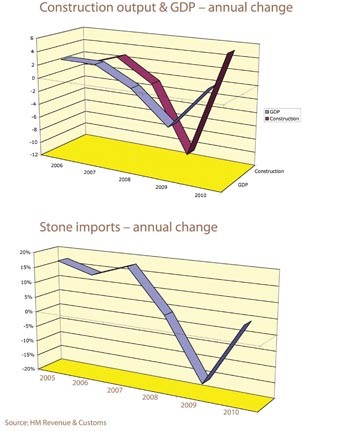
Yet in spite of the problems posed by the weather, both the construction industry in the UK and the economy in general returned to growth in 2010, although the snow did take its inevitable toll on the construction sector with output falling in both the first and fourth quarters of the year.

Nevertheless, the industry performed well in the second and third quarters to grow 5.1% in the year overall, contributing to 1.4% growth in the economy as a whole.

There are no equivalent figures produced in the UK for the stone industry, but with around three-quarters of the stone used in Britain being imported, import figures provide a good snapshot of trends in the industry. And they indicate growth last year was more than 4%.

The fall in construction output in the final quarter of last year could simply mean that work moves forward a month or so, as it did last year.

There are some major developments coming on stream this year and the Olympics are boosting demand for stone in London as hotels, restaurants and public areas such as underground stations prepare for the 2012 games.

Certainly anecdotal evidence from the suppliers of machinery and consumables supports the proposition that the stone industry is gearing up for the opportunities of the year ahead.

There has not been much investment in machines by masonry companies in the UK or Ireland since the world’s bank debt crisis started hitting the rest of the economy in 2008. But according to the companies selling the almost exclusively imported stone processing machinery that is used by the UK stone industry, processing companies started investing again last year to give themselves an edge in an increasingly price sensitive and competitive market place.

That price sensitivity has continued to benefit stone suppliers from the Far East. UK imports from China grew by more than 10% last year and India did even better, up more than 15%. Imports from Asia now account for 58% of stone coming into the UK by value and 68% by volume.

The value of stone imports from Asia first became greater than imports from Europe in 2007 and they have stayed ahead ever since.

Italy is the main European supplier of stone to the UK, but exports to the UK have been hit hard by the fall in the value of sterling, which has increased the price of imports in the UK.

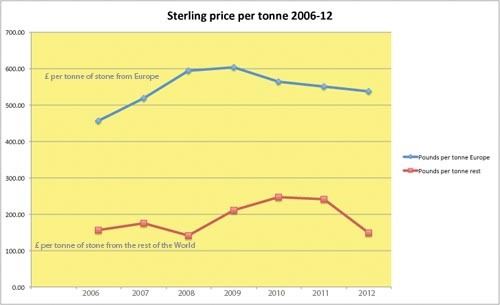
The weakness of sterling has increased the prices of imports from Asia as well as from Europe, but the Chinese and Indians have done more to keep their prices down. Italy has practically conceded the battle on price and is looking to add extra value to the stone it is selling.

You will be able to see some of the ways the Italians are doing that at the Natural Stone Show in the Marmomacc Meets Design feature.

1

They are using their sophistication in design and production to create intricate stone products rather than the more prosaic polished slab, tiles, hard landscaping and memorials that tend to be bought from Asia.

The Italians have certainly increased the price of the products they are selling to the UK. The average price of stone imports from Italy last year was £990 a tonne, compared with an average price from China of £298 a tonne and from India of £223 a tonne.

That probably explains why stone imports from Italy fell by about 40% last year, according to the figures compiled by HM Revenue & Customs.

While most stone used in the UK for most purposes these days is imported, there remain about 300 active quarries run by about 200 operators producing dimensional stone in the UK.

The UK has practically no marble and there is not much granite being extracted these days because it cannot compete with the prices of Asian imports, but the UK does have a good selection of limestones, sandstones and slates that are used for building, interiors and hard landscaping.

It is in demand by the conservation and repair, maintenance & improvement sectors, but is also used in new build, especially in sensitive areas where planners want traditional materials used and in impressive, prestigious buildings where architects want to make a statement. British limestones, sandstones and slates are also used for interiors, especially, but not exclusively, for floors. The subtle, subdued hues of the stones of the British Isles lend themselves to unpolished finishes making statements of quiet authority.

The dimensional stone production industry in the UK is so small that it is considered too commercially sensitive to produce figures about the industry. However, the producers report reasonable strength of demand for their products.

Walling for housing developments has fallen in line with the collapse of housebuilding in general, but where projects are still going ahead the weakness of sterling is making UK stone more competitive against imports.

There was more British stone than ever before being exhibited at the Natural Stone Show this year.

In Ireland, life is hard.

For many years the Celtic Dragon enjoyed greater growth than the UK and invested heavily in equipment to extract and process its own and imported stones. Stone from the UK often went to Ireland for processing because their level of investment gave processors there a competitive advantage.

But the growth peaked in 2006 and they have been in decline since then. In 2009, construction output was just 39% of what it had been in 2006. And by the third quarter of last year (the latest figures available at the time of writing) it had fallen another 39% year-on-year.

But there are signs that the decline in construction in Ireland has reached the bottom of the curve. The economy in general is, perhaps, improving with the government forecasting 1.7% growth this year.

Construction played a major part in the spectacular growth of Ireland that averaged 6% between 1995 and the end of 2006. In 2006, Ireland’s GDP per capita was greater than America’s.

The country’s population was growing as a result of immigration and for the first time in 100 years exceeded 4million, peaking at nearly 4.5million. The extra people needed more houses to live in and offices and factories to work in. Construction boomed.

Fuelled by strong economic growth, immigration and generous tax incentives and grants from the government, as well as low interest rates and loose credit making borrowing easy, property prices increased more rapidly in Ireland in the decade up to 2006 than in any other economy of the developed world. Between 1996 and 2006 prices more than trebled, even though annual completion rates also trebled to 93,000.

Construction seemed to offer guaranteed, no-risk returns, and speculative building raced on. With the crash, Ireland has been left with more buildings than it needs (an excess of 300,000 houses, 17% of its housing stock, according to a report by University College Dublin in 2010) and prices have collapsed, although there were still nearly 20,000 dwellings built last year.

According to the Permanent TSB/ ESRI house price index almost a decade of price rises have been wiped out since 2006. In the third quarter of 2010 the average price of a house fell a further 14.8%, to Euro198,689, compared with a year earlier. That is 36% down on the peak at the end of 2006.

Stone sales in the UK – report May 2010

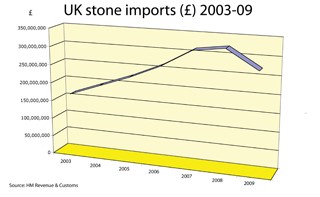
Stone imports to the UK went into decline last year after having held up reasonably well in 2008, when the value of imports was 4% above the 2007 figure. In 2009 the value of imports fell 16%. But that flatters the position. The weakness of stirling (a 15% fall against the Euro and a 25% fall against the US dollar compared with 2007 rates) increased prices through the poor exchange rate. Volumes of stone imports fell by 43%, according to UK government figures.

2

The UK stone industry got off to a good start in 2008, continuing the exceptional growth that had started in 1996 and continued on a general upwards trend well into double figures ever since. However, as the year progressed the reality of the recession started to bite and after April sales began to fall. The year still showed that increase in the value of imports on 2007 overall. Of course, the rise in prices must also have played its part in curtailing demand.

Imports account for the majority of stone sales in the UK. The indigenous stone quarrying industry is so small that no accurate figures for extraction of dimensional stone from the 300 quarries active in the British Isles (which includes Ireland) exist. Anecdotally, sales of British stone had been pulled along with the general increase in demand for stone in Britain throughout the second half of the 1990s and into the new millennium. Again anecdotally, the fall in demand for stone last year was not as bad for home produced stone as it has been for imports.

Leading the growth in stone sales over the past 15 years have been the interiors market (especially granite and latterly engineered quartz worktops and limestone flooring) and hard landscaping. Both benefited from the falling price of imports thanks to the growth of first India and then China as the source of stone and the falling price of diamond tools to process granite. There have also been a relatively large number of palacial private mansions and country houses built in the British Isles. The top end of the market has held up better than the lower end, which tends to help traditional masonry using indigenous stones because these projects are less price sensative than commercial or public sector projects, where the money being spent has to be accounted for to shareholders or tax payers.

Housebuilding has been particularly severeley hit by the recession as buyers fear further price falls could put them into negative equity. In any case, when people believe the price of anything is going to fall, they are likely to wait until it has fallen to buy it. Even if they want to buy, mortgages have become difficult to secure as the banks demand larger deposits and have increased interest rates on loans. The granite worktop and limestone floor and fireplace market have been particularly badly hit. Many kitchen shops have gone out of business and with them their granite worktop suppliers. Small worktop companies who had put their houses up as collateral for money borrowed to invested in a saw and CNC workcentre were particularly vulnerable. Granite, sandstone and other stones (notably porphyry and some limestone) are the preferred choices of hard landscapers and landscape projects have continued, although imports of stone for this sector fell in 2008 and 2009.

Stone use in every area has grown in the past 15 years. Cities have always used stone, internally and externally, for important buildings. There was also an increasing number of fairly modest houses built with stone walls and archetectural masonry, particularly in those areas of Britain that have traditionally built in stone – the villages of The Cotswolds, Yorkshire, central southern England, Scotland and parts of Wales. Here, planners often insisted on locally produced stone being used to match existing buildings and preserve the vernacular character of such areas. But imports also benefited as all over the country housing developments have incorporated stone fireplaces, and stone floors in reception areas and kitchens in particular, but not exclusively. And nearly all this stone is imported. Latterly, underfloor heating has increased the attraction of stone flooring in living areas. England has always had a lot of conservatories added to houses as a home improvement and, with underfloor heating, the attraction of natural stone flooring in conservatories has increased.

Hotels have been refurbished using marble and polished limestone for bathrooms and floors in reception areas and, in some cases, the rooms. Many offices have used marble, granite, limestone and other decorative stones for floors, wall linings, reception desks, stairs, lift surrounds and other public areas, as well as for cladding for the outer skins of the buildings.

The aesthetic for the natural beauty of stone has pervaded most areas of society in Britain and has been used in ever more interesting and intricate ways as the CNC technology for working stone has improved and become more affordable. Even waterjet cutting, which has not made a big impact on the British market, is beginning to be used for creating intricate patters, especially on flooring and paving.

The past 15 years have been a heady time for the growth of the stone market in the UK that has benefited the whole industry and seen a lot of new companies entering the market.

There is a nervousness in the stone industry now that is curtailing any further investment, especially in machinery for processing stone, sales of which had enjoyed the boom in the industry. Following the May election, the new Government has to address the level of debt in the UK and fiscal and monetary measures taken for that will put further pressure on demand. The country as a whole is nervous and fears a dip back into recession. Until confidence returns, there will not be much of an improvement in sales.

Report from 2005: The rapid growth of the stone industry in the UK that began in the second half of the 1990s has continued into the new millennium, mostly fuelled by imports and much of it associated with the falling price of stone in general and granite in particular.

Since the end of the protracted period of inactivity in the construction industry that lasted for the first half of the 1990s, the stone industry has seen continuous growth.

According to a report* by Symonds Group (now Capita Symonds) for the Office of the Deputy Prime Minister that was published in 2004, the volume of dimensional stone imports had increased by 323% to 1,990,000tonnes by 2001 from a low point in 1996.

The stone industry is notoriously under recorded and difficult to pin down in terms of hard figures, but the limited statistics used by Natural Stone Specialist to track the market have shown continued increases in imports every year since then.

We use 16 categories (commodity codes) from HM Revenue & Customs as an indicator of developments. These figures underestimate the amount and value of stone being imported because they do not include all the dimensional stone that comes into the country. However, they do provide a snapshot of the market that can identify trends using comparable data going back to 1997.

Figures for 2004 show the biggest annual growth yet by volume (46%) although growth by value was only 17%.

This is a familiar trend, even if the divergence is unusually extreme. It reflects the falling prices of stone as well as significant growth in low cost natural stone hard landscaping products, granite worktops and natural stone tiles, mostly limestone or travertine. The lower prices are in no small measure due to ever more stone coming from China and India, esepcially, but also of the falling price of travertine, much of which comes from Turkey.

Both India and China have come from practically nowhere in the international trade of stone 15 years ago to being up there with Italy among the world’s largest now. A major factor in that growth is the low price of their stone.

In the build up to the millennium, city, town and village rejuvenation schemes became much more likely to use natural stone for hard landscaping and the trend has continued since then, helped by the falling prices of granite and sandstone hard landscaping products that no longer appear to be such an expensive alternative to concrete or clay. Perhaps the fact that low cost imported stone is available from familiar as well as new sources (many British quarries, for example, have introduced imported ranges) has also helped.

Imports of setts, kerbs and flagstones rose by 104% by volume in 2004 and 74% by value as customers moved away from the recently popular source of such materials, Portugal (volumes down 21%), to India (up 188%) and China (up 210%). It cannot be coincidental that Portugal’s mean price per tonne for these products was £189 while China’s was £119 and India’s £110. And the prices from China and India both fell in 2004, while Portugal’s increased.

An area of burgeoning growth for imports has been granite for worktops, helped both by fashion and, again, the falling price of granite. However, the prices of granite started falling before India and China had made much impression on the market because of vast improvements in the machinery and diamond tooling to work this hard material. Those developments brought down the cost of processing granite.

But the price of imported polished granite is continuing to fall (value of imports in 2004 up 11%, volumes up 21%). Here, though, a significant factor in the fall of the price was Italy, where the value of imports to the UK fell to £628 a tonne in 2004, more in line with prices from India (£614/tonne) and China (£541/tonne), a fall that is not totally unrelated to the fact that Italy is buying a lot of stone from China and India to process and sell on to the rest of the world.

In general, the price of all imported stone is falling, with the value of imports in all five groups represented on the graphs shown in the PDF of pages that can be downloaded below, growing more slowly than the volume of imports. While that continues, demand for imported stone products might reasonably be expected to continue to grow.

The UK producers, especially the northern sandstone quarriers, received a boost from all those Lottery funded Millennium Projects as the previous century came to an end. City, town and village regeneration schemes consumed a lot of stone. Since then, stone has remained popular for such schemes, although, as noted, the stone used is increasingly likely to be imported.

A resumption of activity in commercial building construction, in particular, in the past eight years has helped UK quarriers, especially where planning authorities want to see materials used that match the materials of existing buildings. This consideration has helped the UK’s limestone and sandstone producers.

Planners also like to see vernacular traditions of stone housebuilding continuing in areas such as the Cotswolds, the Peak District and Yorkshire, which have long traditions of building in stone. The concrete alternatives to stone (sometimes called reconstituted stone) that were used in the 1960s and ’70s have not weathered well and planners now often insist on natural stone being used for house and garden walls. Concrete ‘stone’ is more widely still being used for roofs in spite of both indigenous and imported natural stone alternatives being available.

That local stones are more often being required as a condition of planning permission has, again, helped British limestone and sandstone quarriers, not to mention the suppliers of saws, croppers, tumblers and other machinery used for processing the stone.

Production and use of indigenous stone in the UK is even harder to measure than imports because there are many small firms among the 200 quarry operators that produce stone from 300 active and intermittently active quarries in the British Isles.

The figures produced in the Symonds report are generally considered by operating companies to be an accurate reflection of the volumes of stone produced in Britain, many of the larger companies having co-operated with Symonds in preparing the report for the Office of the Deputy Prime Minister.

The figures from 1992 to 2001 presented in the report are reproduced on the ‘UK Production’ graph on the downloadable PDF pages below. Official figures collected since then are incomplete. And they have only ever included figures for volumes as the dimensional stone industry is considered so small as to make values commercially sensitive.

While imports continue to satisfy a burgeoning demand for stone interiors in commercial and domestic properties, especially granite worktops, marble bathrooms, stone-tiled wetrooms and limestone floors, British stone is still finding an eager audience. It is used for cladding new builds, for flooring, wall linings, receptions, landscaping and housing. It is worked on the banker into fine masonry and carvings and is always in demand for sensitive conservation work on the country’s finest buildings.

Source: Stone specialist

The UK stone market report January 2014 – part 4

Report July 2013

It is difficult to put figures on the amount or value of dimensional stone extracted in the UK because most companies winning and processing stone are so small their returns to Companies House are totally exempt. The few that are big enough to submit accounts show how small the industry is – Albion Stone, which quarries and mines Portland limestone, the major building stone of London, had sales of just £4.5million in 2012 and MD Michael Poultney said he had enjoyed a particularly good year. Realstone in Derbyshire has 10 quarries and also imports stone. Its turnover in 2011 was £5.1million.

1

One of the few UK wholesalers that is a PLC is Pisani. Wholesalers sell almost exclusively imported stone, which accounts for the larger part of the UK market. Pisani’s latest accounts (for 2011) show it had a turnover of £16.7million.

Because of the small size of the industry extracting natural dimensional stone in the UK, the figures for production are said to be too sensitive to release. In reality, they are poorly collected. The terminology used in the collection of the data and inaccurate reporting make it impossible to obtain an accurate figure for the amount of dimensional stone produced in the UK. The best that can be done is to look at the commercial and domestic projects using indigenous stone and calculate the amount they are using and the value of it, which is inevitably imprecise.

2

However, the British producers do generally (and it is anecdotal from the producers themselves, although it is supported by their customers) seem to have suffered less than importers since the collapse of the market in 2009. Building stone in the UK and Ireland comes from about 300 active or occasionally active quarries. Some of them are extremely small scale operations, with extraction being carried out on one or two days a year to produce enough stone to meet demand for the rest of the year. Sometimes the quarry is little more than a hole in the corner of a field from which stone is lifted as needed. Many stones are used in quite small geographical areas, which helps give those areas their distinctive built characters.

Imports of stone (including arrivals, as they are called when they come from within the European Union) still constitute the largest part of the UK stone market by quite some degree, according to the best estimates of those involved in the industry. Most stone used in interiors and much of the stone used for granite plinths and stone cladding is imported. Also, much of the granite and sandstone used in hard landscaping is imported and nearly all stone memorials are now imported, mostly from India and China.

Stone used for the walls of houses is mostly indigenous and has been hit by the decline in house building, although, again, not by as much as might have been imagined as builders have tried to add value to what they have built.

Indigenous stone is also used fairly extensively in hard landscaping (although there is more imported granite and sandstone used). Again, the number of hard landscaping projects has fallen since the end of 2008. Local stone is also widely used for property renovation and repair, maintenance and extensions, and for conservation work on significant properties and monuments in the heritage sector.

Margins on stone have fallen during the downturn, which has been reflected in the reported profitability of extractors, processors and fixers. However, indigenous stone suppliers have not been squeezed as hard as importers as the market for indigenous stone seems to lack price elasticity. As one of the UK quarry companies told Natural Stone Specialist magazine, it dropped its prices in 2010, saw no increase in sales, so put them up again in 2012 and has seen no decrease in sales. Why is demand insensitive to price? One reason is that clients do not generally know the price of stone and when a customer wants indigenous stone the price is not the deciding factor in reaching that decision. Another reason is that the use of indigenous stone is often dictated by planners. To get permission to build houses in desirable areas such as the Cotswolds, builders are often left with no choice but to use local stones.

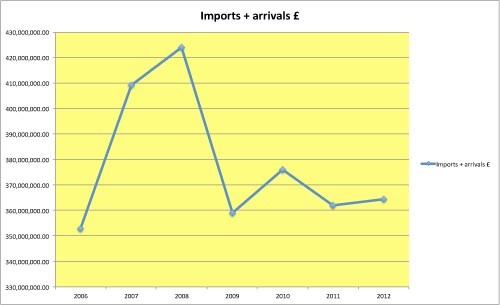
The only presumably reliable figures available about the size of the stone industry in the UK come from HM Revenue & Customs, and they often have peculiarities – although those peculiarities generally disappear over time as the figures are updated. The latest figures, for example, (from which the graphs above were compiled) show a 67% jump in the volume of imports in 2012 while the value went up about 3%. There could have been a big shift to lower value stone, possibly, for example, as the result of the use of a lot of imported stone hard landscaping for the Olympics and perhaps as a result of the Far Eastern companies that have established depots in the UK trading as Stone Yard, KSG (UK), Nile and others. Currency fluctuations also add their complications to comparisons of the value of imports measured in sterling. Nevertheless, experience suggests there could have been an inputting error in the figures that will be corrected in the months ahead. As HMRC tends to be more interested in money than quantities, the value of the imports is usually more reliable than the volume.

According to HMRC, there were £364million worth of dimensional stone imports last year (these figures are amended as the year progresses, but will probably not alter much now). That includes slate (much of which is for roofing) and hard landscaping products. It also includes memorials and excludes some of the stone that will have come into the UK recorded as a product rather than a material (furniture, for example).

If slate and hard landscaping products are removed from the figures (it is not possible to distinguish between stone used for memorials and architectural stone in the figures), the value of the imports left is £265million. Based on Natural Stone Specialist estimates of the value of the market for indigenous stone and the way both indigenous and imported stones are used, that is probably about 77% of the market for architectural and memorial stone (ie excluding slate and hard landscaping – and you can read more about hard landscaping here), leaving the indigenous suppliers with sales of about £80million last year and giving the architectural stone market a total value of around £345million in stone supply.

Once the stone has been sawn, shaped, finished and installed, it is worth considerably more. It is (again) difficult to make an easy calculation about the value added during processing because a piece of stone cropped for walling will have less added value than a polished slab turned into a kitchen worktop, which in turn will have less added value than a 5-tonne block of limestone worked into a Corinthian capital (at least, it appears to have, although when the finished price is divided by the number of hours involved in production, the worktop might look more expensive than the Corinthian capital).

Making an educated guess about the added value, the market at the client end is probably worth about £3,225million. There are around 4,000 companies involved in the various architectural stone markets and another 800 in memorial retailing, making the mean turnover in the sector £670,000 a year.

There were, until 2009, more companies in the kitchen worktop sector, which has suffered particularly badly from the downturn. According to some estimates, about 300 companies, a quarter of the sector, have closed down since the end of 2008 (although some of the directors and employees have subsequently reappeared with new companies, sometimes to the chagrin of their suppliers who have been left holding the debt).

The stone sector grew rapidly after the turn of the millennium on the back of the property bubble but some of the companies that came into the market latterly were too highly geared to be able to survive when demand fell. Others suffered a cash flow crisis when the banks withdrew their support in 2009. Others were able to ride the downturn for a while, but have not been able to survive on the reduced margins as the years have gone by. The slight upturn in stone sales in 2010 has proved to be a dead cat bounce and the market has been basically flat following the bursting of the bubble at the end of 2008. In the middle of 2013, processors going into receivership and leaving bad debts is still a problem for their suppliers.

So far, most of the wholesalers have survived – indeed, new companies have come into the market. Wholesalers of imported stone play a vital role in the distribution chain of the stone industry because there are so many different kinds of stone (and engineered stone alternatives that are also processed by the stone industry) from all over the world. The relatively small size of most processors seldom enables them to gain a price advantage from importing directly. And even if it did, most of them do not want to tie up cash in the amount of stock they need to hold in order to satisfy their customers.

In Ireland, infrastructure is the only light in the construction market as the Government tries to inject some life into economy.

Tough economic times have seen a decline across Ireland’s construction industry, but the infrastructure sector should record positive growth between 2013 and 2017, according to the Timetric report, Construction in Ireland – Key Trends and Opportunities to 2017.
 
Despite a significant decline in the Irish construction industry – a CAGR (compound annual growth rate – or, in this case, shrinkage rate) of -28.25% between 2008 and 2012 – infrastructure is projected to record a CAGR of 1% between 2013 and 2017. This growth can primarily be attributed to various transport plans and government initiatives that are seeking to stimulate the economy.
 
Depressed economic conditions as a result of austerity measures are making it difficult for Irish households to repay housing debt. Furthermore, prospective buyers – especially those taking their first steps on to the property ladder – are finding it difficult to secure mortgages without prohibitively large deposits. Consequently,and despite house building being the largest section of the construction market in Ireland (accounting for 34.7% of total construction output in 2012) it was also one of the worst performing between 2008 and 2012, recording a CAGR of -29.37%.

Customer spending in Ireland has been rendered cautious by high unemployment, low wage growth, and a depressed economic outlook. Combined with businesses’ fear of making large investments as a result of government spending cuts and tax hikes, this has had a significantly detrimental effect on Ireland’s commercial construction market, which has recorded the most significant decline of all sectors – a CAGR of -32.93% between 2008 and 2012.

In the industrial sector, uncertainty in the global economy has had a negative effect on Irish exports, affecting the manufacturing industry in particular. This, coupled with the more general economic malaise, saw the Irish industrial construction sector record a CAGR of -31.36% between 2008 and 2012 – the second largest decline of all Irish construction markets.

Although all sectors of Irish construction registered negative growth between 2008 and 2012, a low benchmark interest rate, various transport plans and government initiatives to stimulate the economy are expected to encourage growth in the infrastructure sector between 2013 and 2017.

For further information: Timetric’s report, ‘Construction in Ireland – Key Trends and Opportunities to 2017’ is available at: http://timetric.com/research/report/CN0132MR

Source: Natural Stone Specialist, the monthly magazine for the natural stone industry in the UK and Ireland since 1882

Source: Stone specialist

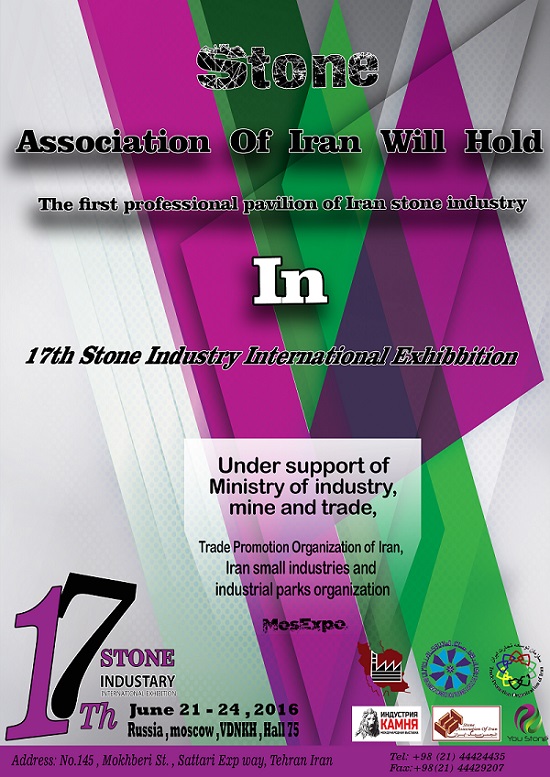
Stone association of Iran will hold The first professional pavilion of Iran stone industry In 17th International Exhibition Stone Industry in Russia

According to the determination of the Russian Federation as one of the target market For development of Iran’s export , material and moral support of ministry of industry , mine and trade , trade promotion organization of iran , iran small industries and industrial parks organization , Stone association of iran in partnership with Youstone will hold .

1.5

Sharify , Stone Association of Iran’s secretary : Emphasizing the strong attendance of Iranian companies in Russia’s Specialized Exhibition of stone

Secretary of the Iran’s stone association emphasized : Unfortunately, in none of the specialized exhibitions we couldn’t attend as worthy of this industry and the main reason was Lack of government support Because the government didn’t consider stone industry in their macroeconomic policies.

He added : Iran’s rival countries in stone portion including Turkey and Italy because of  moral and material government’s support , they took part in international exhibition as pavilion every year . While Iranian companies without any planning took part in specialized exhibitions.

Sharify by referring to agreement between stone association of Iran and Italy said : according to this agreement a stone intercommunion institution will establish and stone association of Italy as our administrator attract Italian companies for holding specialized stone exhibitions.

Secretary of the Iran’s stone association by emphasizing on Iran’s strong companies attendance in specialized exhibition stone industry in Russia said : this exhibition is going to hold on June 2016, in Moscow and 1000 meters pavilion belongs to Iran stone industry .  

Source : Mine 24

Date : 7/March/2016

Mohammad Rassa , YouStone administrative manager in the SAMT interview : Iran’s stone is seeking to a firm foothold in the Russian-speaking countries.

Turkey is the one of countries which could develop it’s stone industry and move toward the improvement . Manufactured stones in this country are exported to various European countries and American thus there are lots of incomes for this country .

However , it seems the power of this country will dwindled in future and Iran could takes its place . Is this probable?

Mohammad Rassa in the SAMT interview :

Penetration to Soviet countries stone market , Russia and other middle east countries which they were under control the Soviet Union, they could be perfect markets for Iran stone industry .

The most important advantage for Iran is being near to these countries , The importance of proximity to producing countries is for that price of transportation is crucial and become a competitive advantage . This matter is more crucial about the stones which have a low price.

Although , Russia , Kazakhstan, Belarus, Turkmenistan, Kyrgyzstan, Azerbaijan etc , Due to not far from Iran, can be potential buyers for country .

According to Rassa , Russia has more importance than other countries. This country among other countries in the region, has the largest market and on the other hand there is competition with other manufacturers of stone . Iran’s stone rivals in Russia are Turkey and China and some other couldn’t compete in this field. Iran has this advantage against China that is nearer to Russia thus Chinese products has high prices in Russia and will lose their competitive advantage.

According to this expert and stone market participants, entering to this market requires, commercial presence in Russian-speaking countries be improved.

Rassa explained :  Our plan is to support Iranian companies strongly in this exhibition so they will grow . In any case, the important thing is that the presence of Iran stones in Russian-speaking countries should be continuously and not enough just to attend a particular time. A strong attendance at the exhibition which will be held in late July is the first step to penetrate the target countries market .

Our plane is expanded to Turkmenistan , Azerbaijan, Ukraine, Kazakhstan in the next steps.

Iran has  lots of marbles in various colors and quality, Travertine is the same as marble.

In these two kinds of stone  , Iran is similar to turkey and can deal with this country’s power. In stones like marble and granite, Iran is better than Turkey and could attain better rank.

Attending in this year exhibition is the first and small step toward our goal and by conversance about stone market participants , experts and architects this goal will be achievable . In the next steps there will be invitation for Iran in other target countries and for experts and companies to have direct communication in big projects in order to receive a strength footmark in global stone market.