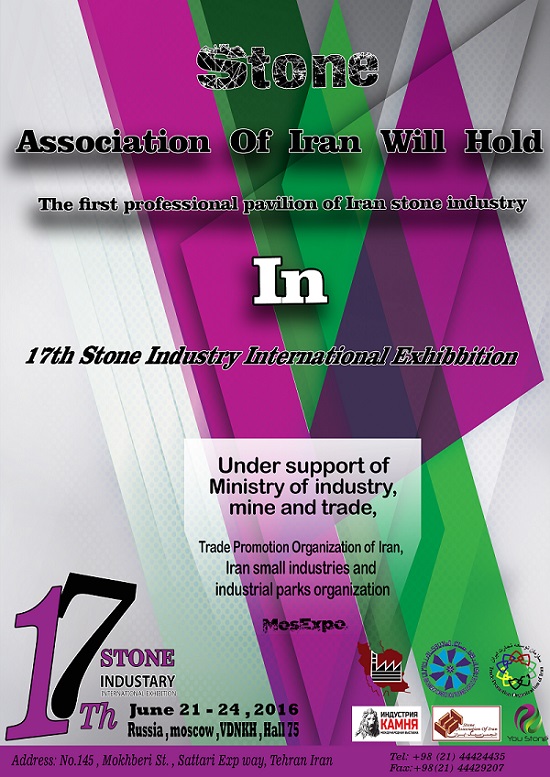
Late July days are marked with reopening of professional exhibitions at Tehran Site. 23th International Exhibition of Tile and Ceramic, 13th International Exhibition of Kitchenware, Bathroom, Sauna, and Swimming Pool Accessories, and 7th International Exhibition of Stone Mines and Related Machineries and Equipment are all going to open on July 20th.
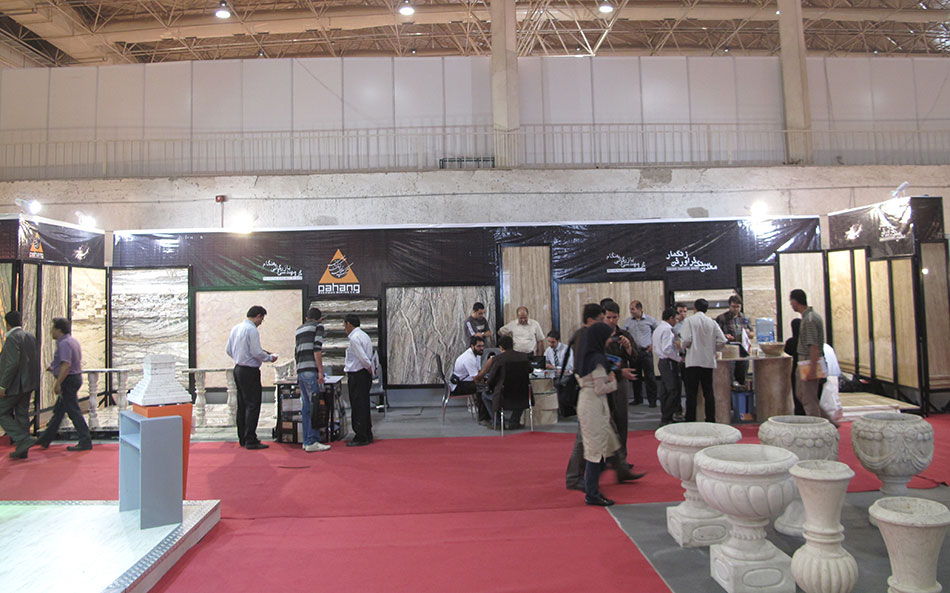
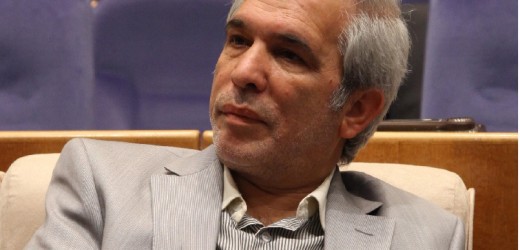
In recent days and in form of exhaustive reports, we carried out investigations into the necessary conditions for holding such exhibitions in countries other than Iran. Now, as we are more and more approaching the opening time of exhibitions, we have the chance to talk with related authorities and administrators. As our first step, we attended Exhibition of Stone, an almost young exhibition with, yet, great significance. Simultaneous with the Sixth Exhibition of Stone (2014), a series of tours to mines and related professional meetings and conferences were held with focus on exploration, mining, processing, sale, and export issues, which well reveals the importance of the exhibition. Here, we have a talk with Abolqasem Shafi’i, head of Iranian Association of Stone and administrator of the exhibition, in order to know more about different dimensions of this professional event. Follow us with SAMT News:
Would you please talk about the exhibition of stone? What are we going to experience here?
The 7th International Exhibition of Stone and Related Machineries and Equipment will, if Allah wills, open in a few days at Tehran Permanent Site for International Exhibitions. In comparison with the former exhibition held in Iran on 2014, the exhibition has a 30-percent increase in space and it covers three main parts: mining, processing, and related machineries.
The exhibition is mainly aimed at clarifying production capacity of domestic and foreign producers, providing a competitive background for and proper communication between researchers, producers, consumers, as well as professional-engineering companies. A total of 100 domestic and 24 foreign companies are going to exhibit their products on a land area of 11.000 square meters from July 20th to July 23th.
With regard to Iran’s new opportunities for international communications, how far have you been successful in attracting foreign producers?
The conditions, for sure, has changed for better. It is for the first time that some European companies, including Spanish and English ones, are taking part in the Iranian exhibition of stone. In addition, some German, Italian, Greek, and Bulgarian companies are present here as the main participants of the event. There are, furthermore, some Chinese, South Korean, Russian, Turkish, and Indian producers accompanying us in the event.
How many counterpart exhibitions of stone and related industries are held in other countries?
There are 12 active countries in stone, mining, and related industries. These countries domestically have the raw materials, which makes them self-sufficient in stone. Germany, Italy, Spain, and Portugal from Europe, India, China, Turkey, and Iran from Asia, Brazil and Mexico from South America, and finally, South Africa and Egypt from Africa are the active forces of the area.
International professional exhibitions, however, are held only in 6 countries. Italy, China, Spain, Turkey, India, and Iran are the six countries who, enjoying rich stone resources, hold great stone exhibitions. There are other countries, of course, such as UAE and Russia, who are active in holding exhibitions, not, however, as producers, rather consumers. These countries have nothing domestic to produce, yet they try to be active in exhibitions, exhibiting their imported stone industry and gain the related advantage.
Which Iranian cities, do you think, are capable of holding related exhibitions of stone?
Isfahan and Mahallat are well qualified for this. Isfahan exhibitions are great exhibitions attracting reputable foreign companies. Isfahan rich mining resources and the corresponding capacities in production of related machinery have made it one of the significant names of the field.
How far can such exhibitions help stone industries’ development?
For sure they have positive influences on improved development procedures. Provided background necessities for domestic production of machinery, ergo independence in the field is one of the changes came true through such exhibitions. I should mention that Iran has a potential 2-billion-dollar export capacity per year, which is not achieved so far. More than 17 million tons of decorative stones are each year extracted in Iran. Holding stone exhibitions is a step toward improved actual export capacity. Anyway, we hope Tehran Exhibition of Stone is ideally held and helps us achieve our desired objectives, particularly within international markets.
Is there any related side events and workshops?
Yes, professional meetings are going to be held so that stone activists will better consult and cooperate with each other.
What are your plans for exhibition’s opening ceremony?
We have invited Mr. Ne’mat-Zadeh, minister of industries, mining, and trade, to be here with us, and he has accepted our invitation. All related deputies as well as members of Iranian Association of Stone are also invited.
Source: SAMT News