All posts by narges Mahdi

The UK stone market report January 2014 – part 3

part3

stéphane Couteaud, the area sales manager for French stone machinery manufacturer Thibaut, summed it up when he said: “What’s going on in the UK and Ireland is very positive. It’s the spark that I hope will ignite all Europe.” And what is going on in the UK (although not Ireland yet) is faster growth than anywhere else in Europe.

Sales of Thibaut (and all other) stone processing machinery in the UK have taken off again as the economy improves and stonemasonry companies need efficiency improvements to keep up with demand.

The UK economy is growing strongly across the board month on month, quarter on quarter, with construction leading the way as one of the largest industries in the UK employing more than 2million people in 250,000 businesses.

And all the predictions are for continued growth. Using a mixture of forecasts from Glenigan and the Construction Products Association as an indication of the growth of the stone industry in the years ahead shows a growth of nearly 20% between 2011 and 2017 (see graph). That will see sales of stone back above their 2008 peak.

And that might underestimate the growthe in the natural stone sector, which has been taking sales from other sectors since the mid-1990s.

Back in the early 1990s limestone and travertine floors were a rareity, especially in domestic property; granite and engineered quartz worktops only appeared at the highest end of the market; hard landscaping was predominantly concrete with some clay. Even though the best commercial buildings were clad in natural stone, many more of them are clad in stone now, with marble, granite and limestone in the public and private interior and toilet areas.

The Millennium gave clients and specifiers a longer-term perspective on their work and now customers have seen the quality and beauty of stone they do not want to go back to using other materials. There is no indication that the appreciation of stone is dwindling.

One of the drivers of the increased use of stone were falling prices as the Far East, in particular India and China, took a rapidly increasing share of the market. There are still those who want the distinctive quality of indigenous and European stones, but there are plenty more who like the economy of imports from further afield. The prices of those imports are now starting to rise – as a result of increasing wages and improved health & safety and environmental controls in the Far East and currency exchange rates as the Far East becomes richer.

Nevetheless, there is a still a huge difference between the price of stone from the Far East and the price of stone from Europe, including the British Isles.

Unable to compete with the low prices from the Far East, Italy, in particular, has striven to add value to its stone, with elaborate cutting and finishing – and with some success. Although the average price of stone from Italy last year was £952 a tonne, compared with £148 a tonne from the Far East, there are still those who want Italian style and quality of production and are prepared to pay for it.

And that is not only true in the UK. According to Internazionale Marmi e Macchina (IMM) Carrara, in January to September last year, Italian companies exported 3,214,718 tonnes of stone at a value of €1.4billion to the rest of the world. That is 3.2% more by volume and 7.2% more in value than in the same period in 2012.

The most significant area of growth was finished marble, with exports of 675,000 tonnes (+4.6%) worth €648.3million (+10.1%).

IMM Chairman Fabio Felici comments: “It is a trend that reinforces the first few months of the year and, more importantly, it is in contrast with the general trend of the economy – testifying to the international appreciation of Italian stone and the importance of the industry that creates employment and added value.”

In the UK, there are those who want to use British stones in particular because these stones are eminently appropriate in historic and sensitive settings… and some people also want to support local industry and people, especially in a recession.

In fact, British quarries in general have not suffered from the economic downturn as much as importers, not least because what has been built has tended to be at the higher end of the market by clients who are more sensitive about the materials they use… or who want to build in areas where planners are more sensitive about it.

With the UK economy growing and stone still a much sought after material in many sectors of construction, there is every indication that, as M Couteaud hoped, the UK will indeed be the spark to ignite the recovery of Europe.

The wider background to UK growth

Just look at the Glenigan* summary for 2013:

  • Glenigan Index for December 2013 up 15% year on year
  • Second consecutive quarter of growth in non-residential construction starts for the first time since 2010

  • Retail starts double the level during the final quarter of 2012
  • Civil engineering starts 41% higher than 2012
  • Education project starts up by 35%.

Figures from the UK Government published in January 2014 and relating to the period to November 2013 confirm this growth trend:

  • Construction output up 2.2% when comparing November 2013 with November 2012, the sixth consecutive month of year on year increase
  • 2% increase in new work and 0.6% increase in repair and maintenance
  • Three months to November up 5.1% on the previous year
  • New work up 5.3%
  • Repair & maintenance up 4.7%

The growth in housebuilding has been particularly pronounced. In the 12 months to October 2013, UK house prices increased 5.5% and in the first 11 months of 2013 (the latest figures available when this was written) public housing construction increased by 10.1% while private house construction grew 13.8 %. This is where stone floors and fireplaces, granite kitchen worktops, splashbacks and tiles, and marble and limestone bathrooms go.

The commercial private sector saw 11.5% growth in the three months to November compared with a year earlier. This produces stone’s major contracts – cladding, large areas of flooring and wall linings, reception areas, bathrooms.

In the 11 months to November last year, the stone industry had already imported more stone than it did in the whole of 2012 and was set for around 8% growth during the year.

It is no wonder the stone industry in the UK has had to invest in new machinery to meet the demand.

But it is not just new machinery that meets the growing demand. All that extra product has to be fixed onsite and growth in the construction industry rapidly translates to employment. Government figures in January showed not only that unemployment was falling but that the number of people employed in the UK has grown significantly.

The UK now has a more than 30million people working – up 485,000 from a year earlier – with unemployment down to 7.1%. The average number of hours worked has also returned to its pre-downturn peak.

Behind the figures lies a major improvement in confidence among Britain’s business community. The Confederation of British Industry (CBI), the UK’s leading business group, is forecasting GDP growth of 2.4% in 2014 rising to 2.6% in 2015, with domestic demand supported by increases in business and housing investment and household disposable income.

John Cridland, CBI Director-General, said: “The UK is now set fair for growth, with confidence returning to Britain’s entrepreneurs. The recovery that started in the service sector has fanned out to manufacturing and construction and is shaping up to be more broad-based.”

The CBI represents the largest of British industry, but small and medium sized enterprises (SMEs, in the jargon) are also felling confident. Vistage is a support organisation the owners and top executives of businesses. Its latest survey has revealed high levels of confidence as we enter 2014.

The Vistage Confidence Index show that 73% of small and medium sized businesses in the UK and Ireland expect the economy to improve this year and 80% are preparing for a significant surge in sales.

They felt 2013 was a much better year for the UK economy, with 76% reporting improved economic conditions compared with a year earlier. At the start of 2013 confidence was a lot lower with only 20% believing business was improving. This positive change in expectations will no doubt continue to contribute to sustainable improvements in the current economic climate, says Steve Gilroy, CEO of Vistage.

Steve Gilroy: “Germany’s medium-sized businesses are rightly feted as the reason for its economic success. By contrast, Britain’s mittelstand companies are the UK economy’s unsung heroes, despite their huge importance to a sustained recovery and sustained job-creation.”

With such a positive outlook for the coming months and years, business leaders are able to focus on making real investments in their businesses.

Steve: “Many [companies] have emerged from the economic malaise of recent years in good health and cash-rich. Our research shows they are expecting a good 2014 and most have active plans to expand their workforces to take advantage of this – in fact many are doing this already.”

*Glenigan is the provider of UK construction project sales leads, market analysis, forecasting, and company intelligence. Its clients include companies of all sizes at every stage of the construction cycle and it has strategic partnerships with The Builders’ Conference, BRE, UKCG, Constructing Excellence, CECA, HBF and GroundSure. Glenigan produces the construction industry Key Performance Indicators survey for ONS and BIS.
Source: Stone specialist

The market for stone in the UK first half 2014 – part 2


report September 2014…

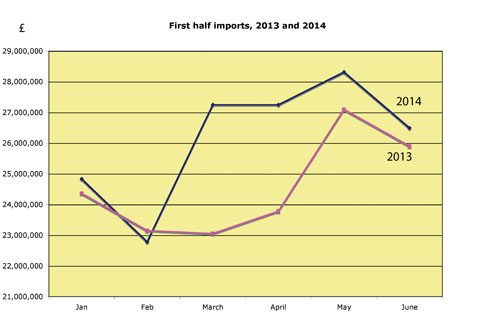
Imports of stone in the second quarter of 2014 continued to increase. They were up 10% on the first quarter of the year and 7% on the same quarter last year, according to figures from HM Revenue & Customs. For the first half of the year as a whole, imports were up 6% on the first half of 2013.

dd

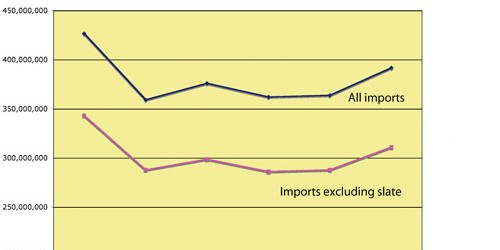
The figures exclude slate, imports of which fell slightly – down 6% on the first quarter and 3% on the second quarter of 2013.


The figures are compiled from VAT returns, so continue to be amended for many months, although early trends are usually reinforced over time.

They also underestimate the market to some extent as some stone products are classified under other product codes. Nevertheless, they are compiled in the same way each period and identify trends. The current trend is clearly upwards, as the graphs here show.

There are no figures produced for British stone production, which probably now accounts for no more than a quarter of the market. However, according to the major operators of British quarries and mines, the trend is also upwards for indigenous stone sales.

dd1

Walling stone sales, which are predominantly British stone, had been badly hit by the drop in housebuilding, but some of the quarries that produce walling stone have reported that, while volumes are down, value has been supported by more masonry and architectural stone being used for larger houses and mansions. Because stone production in the UK is relatively small scale, it does not take many mansions to keep quarries and masons’ workshops busy.

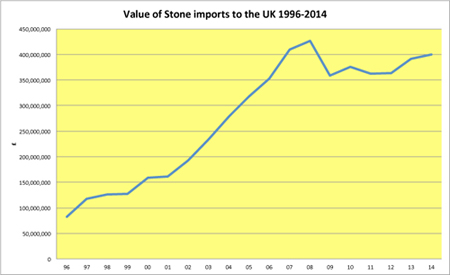
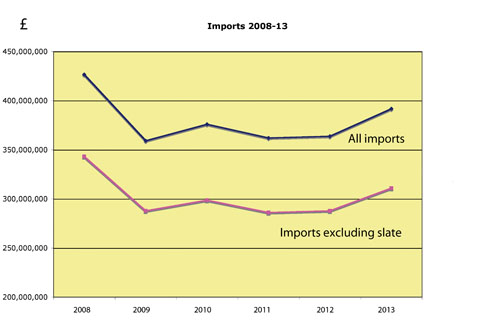
The graph here showing annual stone imports since the height of the market in April 2008 identifies a classic ‘dead cat’ bounce in 2010. The fall in imports in 2009 was worsened by the withdrawal of funding arrangements to many companies by banks, which considerably worsened the impact of the banking crisis on the rest of the economy. 

It is estimated that about 300 stone companies in the UK were forced out of business – around 7.5% of the industry – many of them in the kitchen worktop market, a sector that was hit by the general fall in incomes and consumer confidence and the crash of housebuilding. 

For some, it was only a temporary absence from the market. Others have not returned. Those who remained had to reduce the level of stock held to bring it more in line with the lower level of demand. The effect was to reduce the import of stone below the general level of demand and produce the dead cat bounce in 2010 and the return to recession in 2011 as the market sought equilibrium.

Since then, many parts of the stone market have continued to reflect the improvement in the UK economy in general (the International Monetary Fund says the UK will easily have the highest level of growth in the developed world this year) as the increasing amount of stone being imported indicates.

Most of the stone arriving in the UK still comes from India, China and Italy, if you exclude slate. Slate accounts for much more than half the stone imports from Europe and most of it comes from Spain.

Most stone comes from India. The average price of the 281,500 tonnes of stone that was imported from India in the second quarter this year was £235. The average price of the 110,000tonnes of stone from China in the second quarter of this year was £311. And the average price of just under 16,000 tonnes from Italy was £897.

The figures are not exactly comparable because the products are not exactly the same. For example, quite a lot of sandstone for paving comes from India and sandstone paving is not as expensive as polished granite. Also, a fair amount of the granite from China is setts and kerbs, which are less expensive than polished slabs, while Italy sends a lot of added-value finished stone to the UK. Nevertheless, the trends are clear.


Source: Stone specialist


The growth of the stone market in the UK- part 1


The growth of the stone market in the UK

October 2015

The use of stone in the UK diminished with modern architecture in the first three quarters of the 20th century but has since enjoyed a major revival and demand for it continues to grow strongly as the UK recovers from the economic crash that started with the credit crunch of 2007-8.

Fashions change – most granite worktops installed are dark colours but gradually lighter and more lively colours are growing in popularity. Many would like marble in their kitchens but are put off because marble is easily stained and etched. The makers of engineered quartz are capitalising on this by making products that look more like light-coloured marble but with the strength of granite. Many stone companies supplying worktops these days find half or more of their sales come from quartz.

As the UK construction industry continues to grow out of the recession demand for stone continues to strengthen. The use of stone is now well re-established in all areas of construction – commercial and domestic, for cladding and walling, flooring, worktops, wall coverings, features such as fireplaces and attention grabbing stairs (especially cantilevered stairs and landings).

Hard landscaping has also turned to stone in a major way, both for public and private projects. In 1980 stone paving and walling was a rareity. Now it is only a question of which stone to use. The big change was a huge increase in sandstone from India (in particular) and granite from China (in particular). The low price of these products, coinciding with a growing awareness of the importance of the spaces between buildings and an explosion of major urban regeneration programmes, brought about a sea change in the aesthetic for urban spaces. A driver has been the appreciation local administrations that simply improving the urban landscape can act as an impetus to a lot of private sector in the buildings in an area. This has been the rationale for a lot of urban landscape projects.

Britain and Ireland have a long history of building with stone, with monuments still standing that date back to pre-history – the most famous of which is probably Stone Henge on Salisbury Plain in the south of England, although others, notably Skara Brae in Scotland and New Grange, in Ireland are more impressive to visit.

The Roman conquest and 400-year occupation of Britain left us with stone fortifications and mansions. The Norman invasion of 1066 brought a burst of castle and church building, although it had begun before William the Conqueror turned up at Hastings as religious orders established their cathedrals and monastries across the land.

Stone has always been chosen for structures that are intended to show solidity and permanence, marking out the finest in architecture through the centuries.

With the rise of modernism at the start of the 19th century, architects turned to the then newly developed hard concretes, but as the second millennium drew to a close, architecture in Britain rediscovered its love of stone. Once again, the very symbol of permanence and longevity was chosen to mark out significant buildings and landscapes intended to give the impression of being intended to last for the next 1,000 years. The UK Government made £5billion available to help pay for millenium projects, giving the economy a boost into the third millennium.

Stone continues to be popular. Inevitably sales fell as a result of the world credit crunch and economic crisis of 2007-8.

Between 2008 and 2009, GDP per head in the UK dropped by 5.5%, the largest annual decrease since 1949, another period of austerity. The number of houses being built more than halved and banks withdrew their support for many businesses. The value of stone imports fell 16% in 2009 from what, taken over the long term, now looks like the bubble of 2007-8.

Before the crash there had been a big increase in the number of companies moving into the production and installation of granite kitchen worktops. By 2009, when the economic downturn really hit, there were about 1,200 companies templating, making and installing worktops and the crash saw about a quarter of them go out of business as demand rapidly fell.

Prompted by lifestyle magazine articles and television programmes, granite and, later, engineered quartz worktops had become de rigueur. New builds and home improvements alike just had to have granite worktops. Limestone floors also became popular, as well as stone and marble features such as fireplaces. More recently, stone and marble walls, floors and vanity units have become popular for bathrooms and wet rooms, and stone is more frequently seen in bedrooms and living areas.

In commercial buildings, the City of London leads the way in the use of stone for cladding and masonry on its offices, and stone and marble in its interiors, especially in public areas of foyers and toilets. But all major cities aspire to have stone marking their centres of administration, commerce and entertainment.

Many contractors still turn to Italy as a centre of stone selection and source for major projects in the UK, although Spain, Germany and France also supply cladding and masonry for new build and conservation projects in the UK and, of course, the British Isles produce their own stones, although they only account for about 25% of the market these days.

While larger stone contractors such as Szerelmey, PAYE, Stonewest, Livra, APS, Vetter, Mather & Ellis, Ketton, William Anelay and many more, as well as major interiors stone do buy their stone directly from suppliers all over the world, the recession made companies think again about holding expensive stock and more returned to the traditional supply chain of established international and national wholesalers such as Pisani, Levantina, The Marble & Granite Centre, Gerald Culliford, Beltrami, B-Stone, MGLW, Cosentino, International Stones and many others, as well as specialists in hard landscaping, roofing and memorials. They are all listed with full contact details in the Natural Stone Directory, which can be bought online from www.naturalstonespecialist.com/directory.

After the crash of 2009 there was a dead cat bounce in 2010, and adjustment back down in 2011 and each of the three completed years since then have seen stone imports growing again, with volume outpacing value, reflecting the strength of sterling and, perhaps, a hardening of attitudes by buyers.

According to the figures from HM Revenue & Customs, the value of imports in 2014 grew a little more than 2% to just over £400million for nearly 3million tonnes of stone. Figures for UK stone production (mostly limestone and sandstone and a little granite) are sketchy. However, according to the British Geological Survey, UK production was a little under 1million tonnes, which the Minerals Products Association’s Dimension Stone Group values at about £350million.

An upward trend in the market is clear, reflecting both the growth in British construction (up 7.4% in 2014) and the economy in general (up 2.8%).

Direct imports from India and China continue to grow and for the first time last year the two countries supplied more than half the UK’s stone imports. India still supplies most (nearly £127million worth last year) but China’s contribution was up 5% at just over £74million.

From Europe, Spain has maintained its position as the UK’s major supplier, not least because it ships a lot of roofing slate to Britain as well as granite for hard landscaping. In 2014 it was the source of 138,000tonnes of natural stone products valued at £58million.

Italy’s importance as a supplier to the UK has been diminishing, slowly but inexorably, for many years. At the height of the market in 2008 it shipped 51,000tonnes of stone to the UK valued in sterling at £52million. Last year that was 31,000tonnes worth £30million, according to MH Revenue & Customs.

Italy is still respected for its high quality finished stone and many developers continue to turn to Italy to source large quantities of natural materials for top-of-the-market projects, but clearly alternative sources are also being used.

  • The usual caveats apply to these figures: they are based on VAT returns and some products can slip through under different product categories, so do not show up as stone imports. No doubt some stone that would not normally be considered part of the stonemason’s repertoire is also included. Nevetheless, the figures are comparable over time and provide the best source of information available to the industry about trends in the use of natural stone.
  • No independent value is reported for the indigenous stone industry in the UK, which has about 170 quarry and mine operators supplying dimensional stone extracted from about 250 quarries and mines in the British Isles. The stone is used almost exclusively for the home market, although a little goes overseas.


UK stone market continues to grow

June 2015

For the third successive year, the UK’s imports of stone for construction and memorials grew again in 2014. Volume growth once again outpaced the growth in the value of them, reflecting the strength of sterling and, perhaps, a hardening of attitudes by buyers.

According to the figures from HM Revenue & Customs, the value of imports last year grew a little more than 2% to just over £400million while the volume was up 37% at nearly 3million tonnes. According to the British Geological Survey, UK production was a little under 1million tonnes, which the Minerals Products Association’s Dimension Stone Group values at about £350million.

Because the stone sector is fairly small, fluctuations in prices and volumes are quite large because they can be influenced by a small number of projects. Nevertheless, an upward trend in the market is clear, reflecting both the growth in British construction (up 7.4% in 2014) and the economy in general (up 2.8%).

Direct imports from India and China continue to grow and for the first time last year the two countries supplied more than half the UK’s stone imports. India still supplies most (nearly £127million worth last year) but China’s contribution was up 5% at just over £74million.

Imports from South Korea are increasing – it supplied 2,000tonnes in 2014 worth £2million, making its price per tonne about the same as stone from Italy. More is coming directly from Latin America (2014 = 36,000tonnes valued at £12million). There is an increasing amount from the Middle East and North Africa (2014 = 17,500 tonnes valued at £10million).

From Europe, Spain has maintained its position as the UK’s major supplier, not least because it ships a lot of roofing slate to Britain as well as granite for hard landscaping. In 2014 it was the source of 138,000tonnes of natural stone products valued at £58million.

Italy is Europe’s largest stone trading nation but its importance as a supplier to the UK has been diminishing, slowly but inexorably, for many years. At the height of the market in 2008 it shipped 51,000tonnes of stone to the UK valued in sterling at £52million. Last year that was 31,000tonnes worth £30million.

Italy is still respected for its high quality finished stone and many developers continue to turn to Italy to source large quantities of natural materials for top-of-the-market projects, but clearly alternative sources are also being used.

·         The usual caveats apply to these figures: they are based on VAT returns and some products can slip through under different product categories, so do not show up as stone imports. No doubt some stone that would not normally be considered part of the stonemason’s repertoire is also included. Nevetheless, the figures are comparable over time and provide the best source of information available to the industry about trends in the use of natural stone. Also the figures continue to be amended for many months after they first appear.
·         No independent value is reported for the indigenous stone industry in the UK, which has about 170 quarry and mine operators supplying dimensional stone extracted from about 250 quarries and mines in the British Isles. The stone is used almost exclusively for the home market, although a little goes overseas. More Irish stone is exported, especially the Irish Blue limestone that goes to the Netherlands and Belgium, where it is used as a match for the Belgian Blue (Petit Granite).


Source: Stone specialist